
The RVA Blog & Podcast
How to run a better MSP.
Field notes and podcast episodes for MSP operators — on building capability, not just headcount. Every post leads with a hypothesis, then proves it with operating reality: ticket lifecycle, gross margin per technician, the vCIO motion, onboarding ramp. Written by Andrew Moore, an operator who took an MSP from startup to private-equity exit.
Featured
-
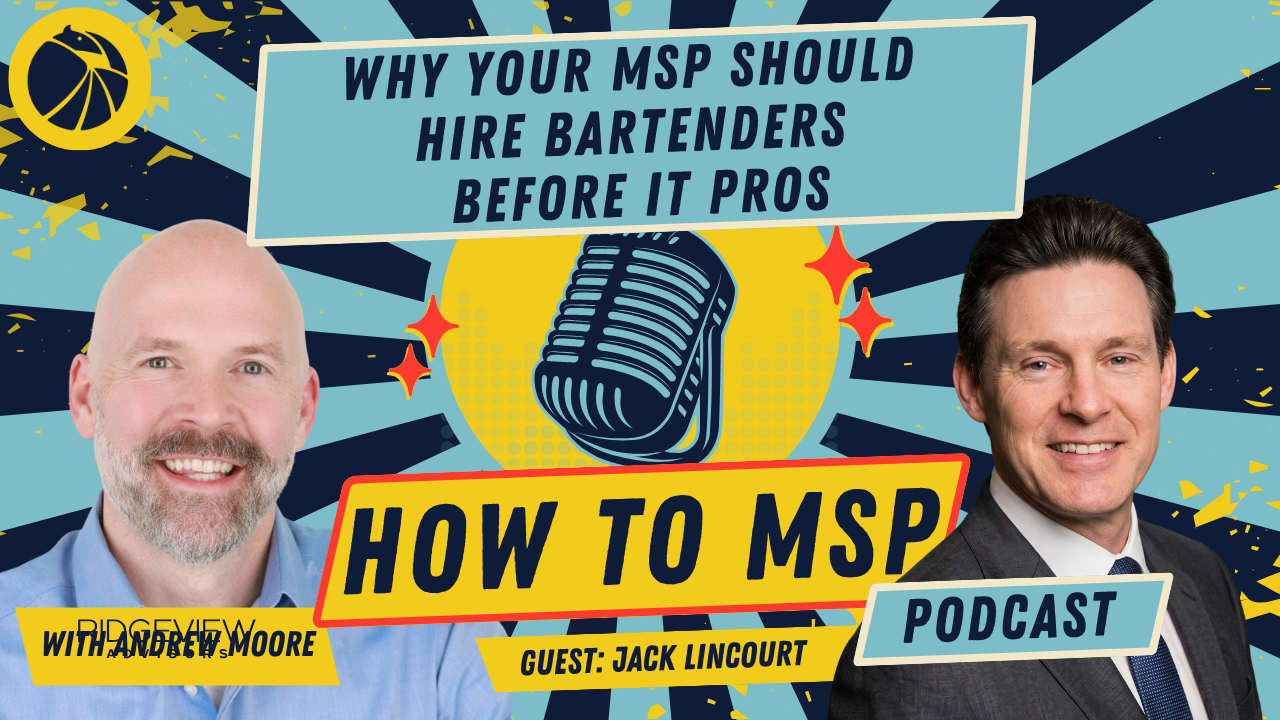
Why Your MSP Should Hire Bartenders Before IT Pros
Jack Lincourt of Microtime gets brand-new hires with zero IT experience handling 85% of MSP tickets in 90 days by hiring for chaos tolerance, not certs.
Open the episode → -
Per-User vs. Flat Fee: What Is the Best MSP Pricing Model?
Per-user and flat-fee pricing both cap your MSP's value at headcount. The model that wins is priced to outcomes. Here's how to choose and evolve.
Read the post → -
Pig Tossing Is Hurting Your MSP and Clients
Tossing a complex deliverable to the next team without planning is 'pig tossing.' It erodes client trust. Here's how to replace it with gentle, planned handoffs.
Read the post →


-
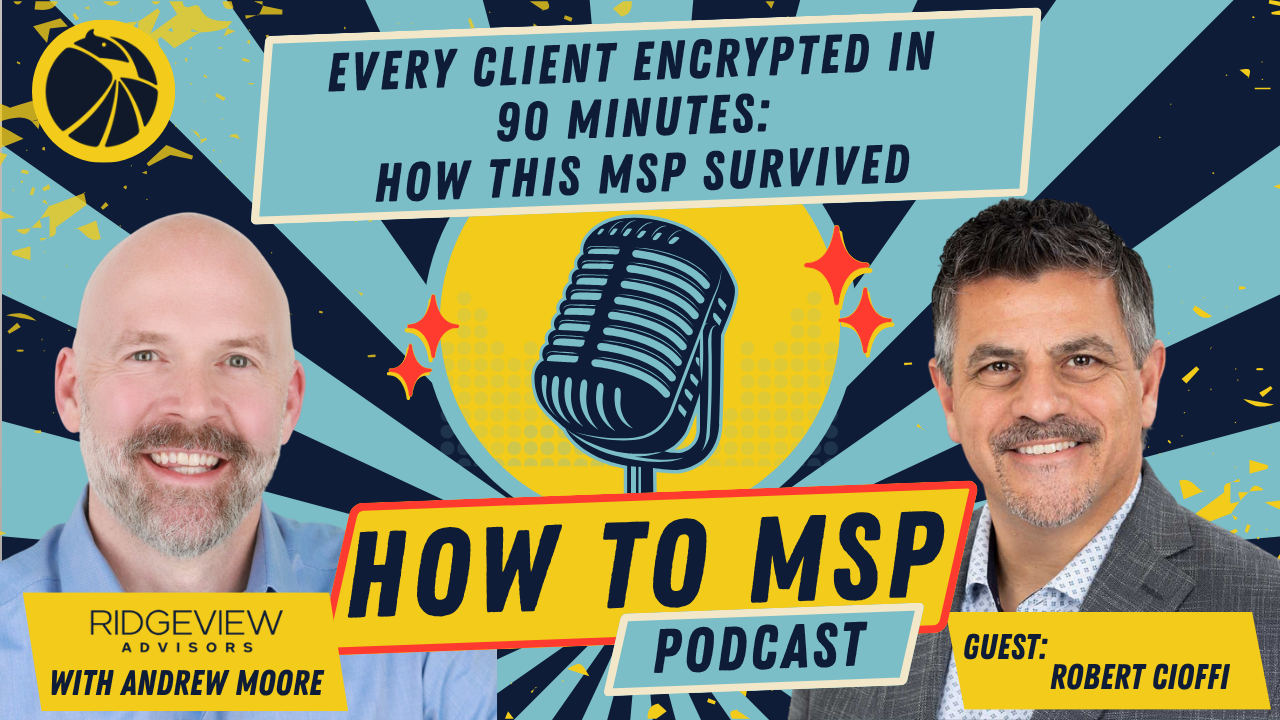
Every Client Encrypted in 90 Minutes: How This MSP Survived
A zero day in Progressive Computing's RMM encrypted 2,500 endpoints in 90 minutes. Robert Cioffi on the recovery, and the 27 competitors who showed up.
Open the episode → -
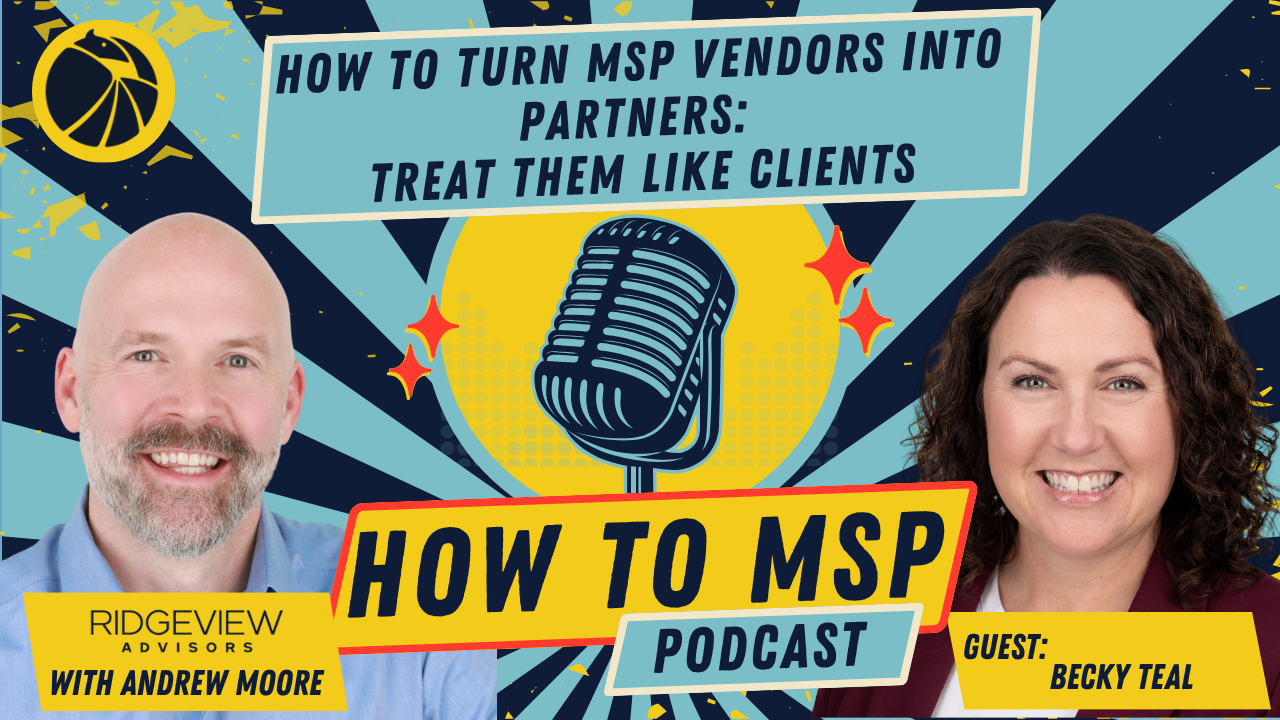
How to Turn MSP Vendors Into Partners: Treat Them Like Clients
Becky Teal of Huntress explains why MSPs lose vendors the same way they lose clients, and what the channel gives away free to the partners who ask for it.
Open the episode → -
When Should You Hire Your First MSP Service Manager?
If you spend more than half your day in the ticket board, you're already behind. Here's when to hire your first MSP service manager, and how to build a second line.
Read the post → -
Stop Mining Clients for MSP Referrals: Recruit Their Vendors
Most MSPs run out of referrals because they ask happy clients. Bill Poole explains why the vendors already sitting in those clients' offices are the better source.
Open the episode → -
Stop the Churn: How SBRs Turn Techs into Trusted Advisors
Fast ticket resolution isn't a retention strategy. It's the baseline. The Strategic Business Review is how MSPs move from fix-it vendor to trusted advisor.
Read the post → -
Own Your Tools: A Practical Guide to Reducing MSP Tool Sprawl
MSP tool sprawl is an invisible margin killer. Here's the four-step framework to audit, consolidate, and own a tech stack that actually drives throughput.
Read the post → -
Stop the Valuation Leak: How to Build an MSP That Survives Investor Scrutiny
Investors buy predictable, de-risked throughput, not your history or your potential. Here's how to stop the valuation leaks before due diligence finds them.
Read the post → -
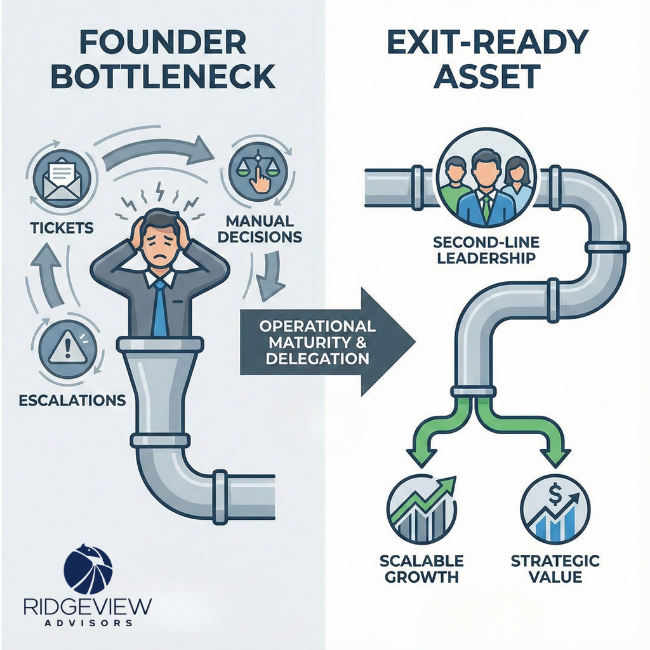
End the Founder Bottleneck: Build an Exit-Ready MSP That Performs Without You
Buyers don't pay for past profit. They pay for a business that runs without you. Here's how to remove the founder bottleneck and build real exit value.
Read the post → -
Why Your MSP Should Hire Bartenders Before IT Pros
Jack Lincourt of Microtime gets brand-new hires with zero IT experience handling 85% of MSP tickets in 90 days by hiring for chaos tolerance, not certs.
Open the episode → -
Why SMBs Will Soon Spend More on AI Than Security: What It Means for MSPs
Jimmy Hatzell of Hatz AI on why the average SMB will spend more on AI than security within two years, and the playbook MSPs should run this quarter.
Open the episode → -
How Do You Sell Compliance-as-a-Service (CaaS) to Reluctant SMBs?
Sell CaaS by leading with a risk assessment, not a quote. Turn GRC into recurring revenue and reposition your MSP from vendor to risk advisor.
Read the post → -
Stop Failing at EOS: Why Your "Chaos OS" Is Killing Your MSP Growth
Larry Garcia of Strety on why running your MSP in reactive chaos burns the same energy as an accountability framework, so you might as well spend it on task.
Open the episode → -
The MSP Engine: Aligning Sales and Operations for High-Margin Growth
Ashton Solutions' leadership on aligning sales and operations into one MSP engine that protects margin, sets client expectations, and lets you say no to bad deals.
Open the episode → -
Protect Your Margins: Why Every High-Growth MSP Needs a Quarterly 180
A quarterly 180, a structured operational retrospective, is how high-growth MSPs find the efficiency leaks that quietly drain margin and valuation.
Read the post → -
Setting Expectations With Your MSP Clients & Team
Connor Fagan of Renada on escaping the ambiguity trap: simple, repeatable process, commander's intent over scripts, the 60% rule, and where AI actually helps an MSP.
Open the episode → -
Stop Bolting AI to Broken Processes: Building the Evergreen Service Desk
Automation amplifies chaos, it doesn't fix it. Build an operational engine on three pillars, Momentum, Precision, and Accountability, before you add AI to your MSP service desk.
Read the post → -
Per-User vs. Flat Fee: What Is the Best MSP Pricing Model?
Per-user and flat-fee pricing both cap your MSP's value at headcount. The model that wins is priced to outcomes. Here's how to choose and evolve.
Read the post → -
MSP Valuation Secrets: How to Maximize EBITDA Multiples for Your Exit
Reed Warren of iT Valuations on what actually moves your MSP's multiple: growth rate, the rule of 40, recurring-revenue mix, and exit-ready hygiene.
Open the episode → -
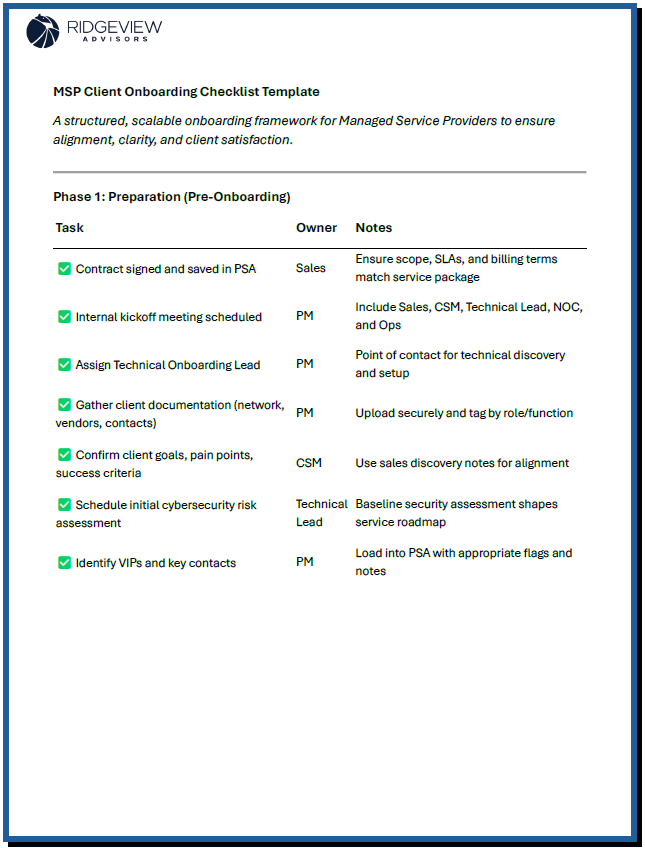
What Should Be in Your MSP Onboarding Checklist?
A strong MSP onboarding checklist runs three stages (Preparation, Execution, Transition) anchored by a risk assessment. Here's what belongs in each.
Read the post → -
Why Is My Service Desk On Fire?: Building an MSP Service Desk with Data, Process & Heart
Mark Sowden, former VP of Service at IronEdge, on running an MSP service desk with clean data, the right KPIs, pod-based span of control, and a talent-generator mindset.
Open the episode → -
How Do You Perform a Cybersecurity Risk Assessment for SMBs?
A cybersecurity risk assessment is a structured, repeatable process, not a one-time audit. Here's how MSPs run one and turn it into proactive, risk-aware service.
Read the post → -
The Death of Traditional MSP Outsourcing: Why Staff Augmentation Trumps Outsourcing
Scaled's Jason Knight on why traditional MSP outsourcing fails and how dedicated staff augmentation - with real onboarding discipline - adds capacity, margin, and EBITDA.
Open the episode → -
Why MSPs Screw Up Hiring
VAR Staffing's James Bier on why MSP hiring fails - active vs. passive candidates, scenario-based vetting, and recruiting undervalued talent Moneyball-style.
Open the episode → -
How to Build an MSP Service Catalog
No menu, no kitchen can run. A service catalog and SLAs set client expectations, protect margin, and end the 'but you're my IT provider' problem. Here's how.
Read the post → -
Stop Selling Work: Why MRR Outperforms NRR in MSP Value Creation
A dollar of recurring revenue is worth more than a dollar of project revenue. Here's why the project trap caps your valuation and how to escape it.
Read the post → -
Building Successful Remote Teams in Your MSP
LISS Technologies' Jon Katz on scaling an MSP service desk with remote 'pods' - the Rule of 8, hiring L2/L3 remotely, and running accountability without an office.
Open the episode → -
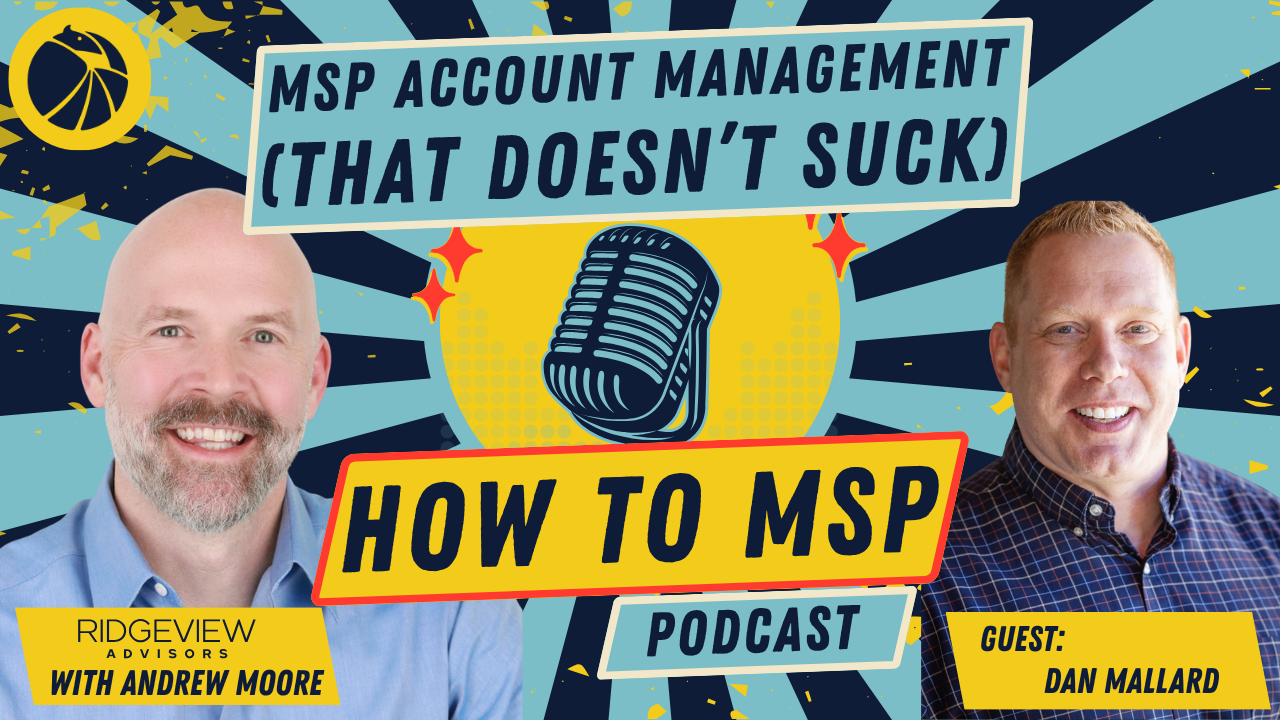
How to Build an MSP Account Management Process (That Doesn't Suck)
IronEdge's Dan Mallard on building an MSP account-management layer that retains clients: real SBRs, Red/Yellow/Green client health, and who should own the relationship.
Open the episode → -
Tapping the Armadillo: How to Manage Processes & People
Pointing your team at the goal and letting them run isn't leadership. What an armadillo race taught me about guiding people and processes to the finish line.
Read the post → -
The Flight Plan to a Higher Multiple: Turning Your MSP into an Investor Magnet
Valuation isn't luck; it's something you build. The flight plan to a higher multiple: recurring revenue, the right KPIs, and a company that runs without you.
Read the post → -
The Accountability Flywheel: How MSPs Build Alignment and Keep Teams Focused
Delegating tasks but still the bottleneck for every decision? Accountability is the missing piece. Build the flywheel that keeps your MSP moving without you.
Read the post → -
Building an MSP That Buyers Want: Lessons From the Private Equity Playbook
PE firms buy specific traits: recurring revenue, leadership depth, operational discipline, clean books. Build them now, not in the 90 days before you sell.
Read the post → -
Stop Leaving Money on the Table: How Smart MSPs Expand Gross Margin Without Raising Prices
Most MSPs leave 5 to 10 points of gross margin on the table. Smarter procurement, packaging, and operational discipline expand margin without charging more.
Read the post → -
The $50,000 Hour: Why MSP Owners Must Work On the Business, Not Just In It
Your most valuable hour isn't spent closing a ticket. It's spent on decisions worth tens of thousands. Here's how to reclaim and protect the $50,000 Hour.
Read the post → -
Why Trust Is Your MSP's Best Competitive Advantage
Your MSP isn't selling IT services. It's selling trust. Here's how to operationalize trust into your sales, onboarding, and delivery so it scales and sells.
Read the post → -
Cohorts, Coaches, and Culture: Why MSPs Thrive Faster in a Guided Group Program
Running an MSP is isolating, and DIY growth stalls. Cohorts plus coaches is the formula: accountability, a shorter learning curve, and culture change at the top.
Read the post → -
From Chaos to Clarity: The KPIs Every MSP Must Track to Increase Valuation
You can't scale or sell an MSP on gut feel. Track the financial, operational, and leading KPIs that create clarity and the valuation that follows.
Read the post → -
The Dirty Dozen: How Fixing 12 Clients Can Transform Your MSP's Profitability
Rank your clients by gross margin, take the worst 12, and fix, raise, or exit each one. It reclaims profit and raises valuation without adding a single client.
Read the post → -
Doing What You Sell: Aligning Sales and Operations for Your MSP
Trust breaks when what's sold doesn't match what's delivered. Align sales and operations around standardized solutions that customize without going bespoke, and keep it.
Read the post → -
From Vendor Chaos to a Value Stack: How to Build a Service Offering That Scales
A tech junk drawer eats margin and blocks scale. Standardize the stack, consolidate vendors, and turn your tools into priced service bundles buyers reward.
Read the post → -
3 Rules of Conference Sponsorship for MSPs: Maximizing Your Trade Show ROI
A booth buys visibility; a speaking spot buys authority. The 3 L's of trade-show ROI for MSPs: Location, Lists, and Live speaking, and why a booth alone fails.
Read the post → -
8 Steps to Better MSP Marketing Lead Generation
MSP lead generation works when you help instead of sell. Eight steps to position yourself as the trusted advisor: content, video, social, events, follow-through.
Read the post → -
Pig Tossing Is Hurting Your MSP and Clients
Tossing a complex deliverable to the next team without planning is 'pig tossing.' It erodes client trust. Here's how to replace it with gentle, planned handoffs.
Read the post → -
Your Sales Funnel Is Leaking: What Cost-of-Acquisition Can Teach You
Most MSPs don't know what a new client really costs to land. Tracking cost of acquisition (CAC) is more than a sales exercise; it's a valuation strategy.
Read the post → -
MSP Automation: Because "Oops!" Is Not a Business Plan
Automation isn't a labor shortcut, it's a trust engine. How MSPs use automation for consistency, not just efficiency, to protect client trust and margin.
Read the post → -
Scaling Yourself Out of the Day-to-Day: How MSP Owners Can Stop Being the Bottleneck
If you disappeared for 30 days, would your MSP keep running? Stop being the bottleneck by building middle management and accountability systems, then step back.
Read the post →



























Build the capability, not just the headcount.
Talk to RVA about an L&D program, a cohort, or executive coaching built for the way MSPs actually run.