
Why Your MSP Should Hire Bartenders Before IT Pros
Jack Lincourt's help desk at Microtime Computers handles 85% of incoming tickets with technicians who, three months earlier, had never touched IT. Some of them came from Dunkin' Donuts drive-throughs. Some came from grocery store registers. None of them came from another MSP — and that, Jack will tell you, is deliberate.
"If you can find the time to spend time with your team and build that relationship with them, they'll work hard for you, because they know you're working hard for them."
— Jack Lincourt

How Do You Sell Compliance-as-a-Service (CaaS) to Reluctant SMBs?
When talking to prospects, focus on the risks that keep them up at night:
Insurance Eligibility: Can they actually get a payout if they are breached, or will their lack of controls void the policy?
Vendor Lock-outs: Are they losing contracts because they can’t pass a security questionnaire from a larger partner?
Operational Resilience: It’s not about "being compliant"; it’s about having a documented, repeatable process that ensures the business survives a "180" review (a complete pivot or retrospective assessment) of their security posture.
Stop Failing at EOS: Why Your "Chaos OS" is Killing Your MSP Growth
Whether you are struggling with "ride or die" employees who no longer fit or trying to upskill your team for the AI era, this conversation provides the blueprint for moving from accidental management to intentional scale.
Quote of the Episode
"The chaos operating system in your head... is burning the same amount of calories as an accountable framework where you're on task. You're already spending the energy—you might as well spend it on being on task." — Larry Garcia.
The MSP Engine: Aligning Sales & Operations for High-Margin Growth | Feat. Ashton Solutions
In this episode, host Andrew Moore sits down with the leadership team from Ashton Solutions—Travis Grundke, Jim Abbott, and Tom Foley—to pull back the curtain on how they’ve aligned their organization for over two decades. From the "6-week onboarding rule" to the art of saying "no" to bad business, this conversation is a masterclass in MSP maturity.
Key takeaways from this episode include:
The Power of Expectations: Why you must tell prospects about remediation projects before they sign the contract.
Process vs. Magic: How to transition from owner-led selling to a scalable, process-driven sales engine using the EOS framework.
The Actuarial MSP: Viewing your contracts through the lens of risk management and profitability.
The "Spider Sense": How to identify "red flag" clients before they ever touch your service desk.
The Future of AI: Moving past the hype to find real-world business outcomes for your clients.

Protect Your Margins: Why Every High-Growth MSP Needs a Quarterly ‘180’
A 180 is a dedicated time for the team to step back from day-to-day service delivery to reflect on how they work together. It’s about turning away from the daily grind to look at the bigger picture of operational health.
While some industries do this every two weeks, for most MSPs, a quarterly 180 rhythm is the sweet spot. It provides enough data to see trends without being an administrative burden.
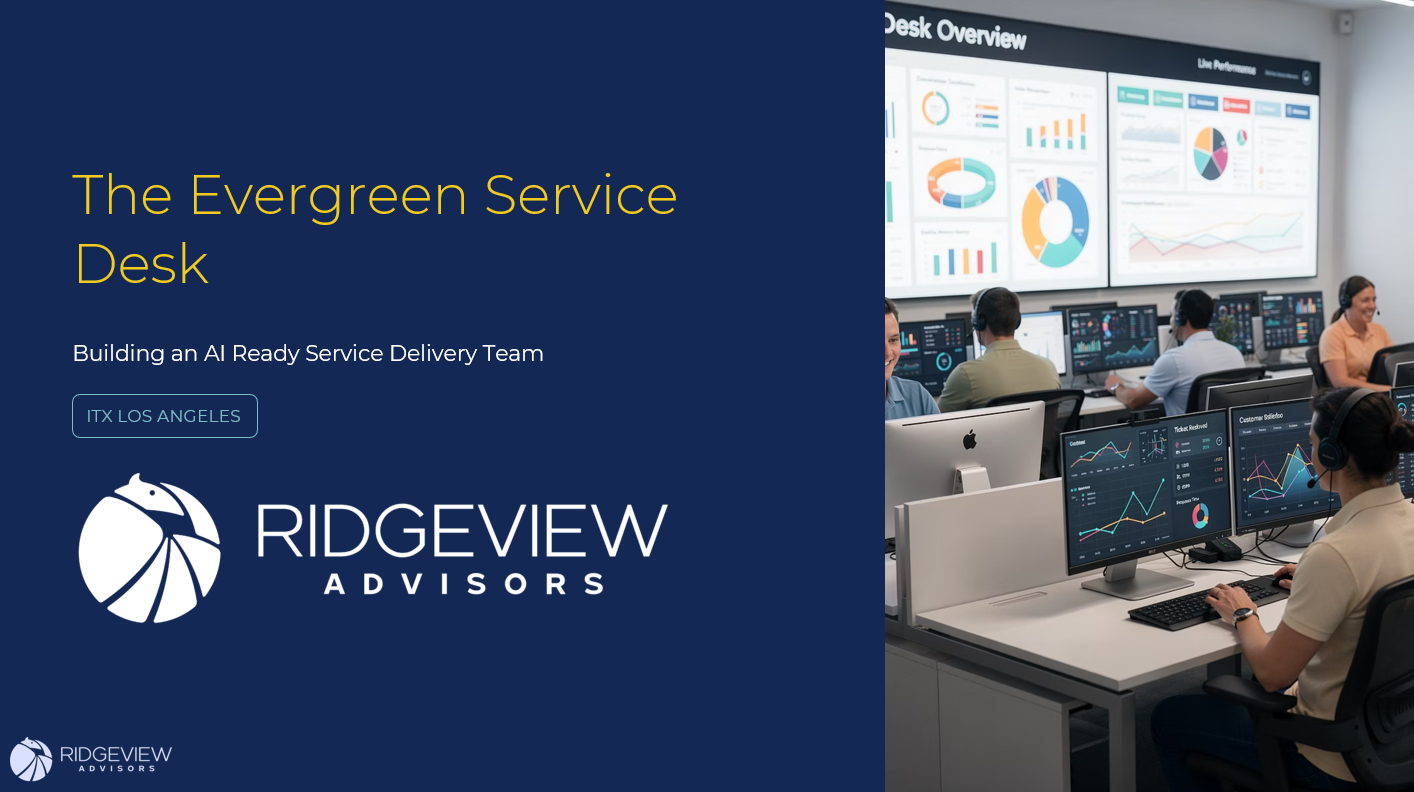
The Evergreen Service Desk
Before you automate, you must understand. By mapping every point where a human "touches" a process, you gain the clarity needed to strategically insert AI microtools that actually enhance efficiency.
The tools will change, but the engine remains the same. Built for today, ready for whatever comes next.

What Should Be In Your MSP Onboarding Checklist?
Repeatability is the key to growth. If your onboarding process is reinvented for every client, it becomes a bottleneck that drags down your team and increases delivery risk. That’s why your checklist must be:
Standardized: Applied consistently across all new clients
Flexible: Accommodates slight variations without becoming bespoke
Documented: Supported by templates, SOPs, and internal tools
Tracked: Integrated into your PSA for accountability and reporting
This structure allows you to onboard more clients, faster, while maintaining a high standard of delivery. It also gives your operations team confidence that what was sold can actually be fulfilled—without pig tossing or scope confusion.
Your Service Desk Is Trash: How to Build an MSP Service Desk with Data, Process & Heart
In this episode of How to MSP, host Andrew Moore welcomes Mark Sowden, a 20-year MSP veteran and former Vice President of Service who has built award-winning delivery teams from the ground up. Mark breaks down the exact strategies used to whip chaotic service desks into shape, focusing on accountability, data integrity, and scalable team structures.

How Do You Perform a Cybersecurity Risk Assessment for SMBs?
At the core of any risk-aware strategy is a cybersecurity risk assessment. This is not a one-time technical audit. It’s a structured, repeatable process that evaluates vulnerabilities, identifies likely attack vectors, and prioritizes remediation based on business impact.
For SMBs, this process is often eye-opening. Many are unaware of the full scope of their digital exposure or assume their size makes them less attractive to attackers.
How to Scale Your MSP Service Desk: The "Pod" Structure & Remote Teams
One of the biggest challenges discussed in this episode is the "breaking point" that occurs when an MSP service desk hits about 10–12 people. At this size, a single Service Manager can no longer effectively manage every ticket and every engineer.
Jon Katz introduces the solution LISS Technologies implemented: The Pod Structure.
How to Build an MSP Account Management Process (That Doesn't Suck)
Most MSPs treat QBRs as a "technical report card." They walk into the client meeting with a stack of reports showing ticket counts, patch statistics, and uptime percentages.
The hard truth? Your clients do not care about ticket counts. They assume you are patching their servers—that’s what they pay you for. When you focus solely on metrics, you are commoditizing your service. You are reminding them that you are an expense, not a partner.

How to Build an MSP Service Catalog
To run your IT services like a well-oiled diner, it’s essential to create a detailed service catalog that ties directly to your contracts. Here are four areas to focus on when building yours:
Alerting and Monitoring – Define how and when your MSP alerts clients to issues. Is there proactive monitoring? If so, what’s the response time for different alert levels?
Updates and Maintenance – Make it clear what is included in standard support, like Office 365 updates, and what falls under more specialized services, such as firewall firmware updates tied to security or vulnerability management.
Response Times – Set realistic expectations with SLAs that clearly define response and resolution times for different levels of service requests. Clients should know when to expect a resolution for minor issues versus critical outages.

Doing What You Sell: Aligning Sales and Operations for Your MSP
For any Managed Services Provider (MSP), trust is the foundation of long-term client relationships. From the moment your sales team engages a prospect, to the seamless delivery of services by operations, maintaining that trust is essential. However, many MSPs stumble along the way, especially when there’s a misalignment between sales and operations or when the services sold don’t match what’s delivered.
How can an MSP build trust that begins in the sales process and carries through operational execution? The answer lies in aligning sales and operations around standardized solutions that allow for customization without becoming bespoke, ensuring clear communication and consistent delivery.

Tapping the Armadillo: How to Manage Processes & People
Imagine you’re at the helm of a business project. You’ve set everything up—a clear process, tools, and resources. You’ve picked the right team members, just like I picked my armadillo, confident that they have what it takes to deliver great results. Like me with my armadillo, you’ve seen promising signs that they’re equipped for success. You align everything toward the goal, the finish line in sight.
Then, the project kicks off—much like the start of my armadillo race. But instead of racing toward the goal as expected, something goes sideways. The project (or in my case, the armadillo) veers off course. Despite your best efforts in preparation, your team or process falters, heading in an unexpected direction.

Pig Tossing is Hurting Your MSP and Clients
In many Managed Services Providers (MSPs), there’s a recurring issue that we can call “pig tossing.” Imagine tossing a large, complicated deliverable, project, or client transition to another department or team without proper planning or communication—like throwing a pig over a fence and expecting someone to catch it without injury to themselves or the pig. The outcome is predictable: a chaotic process that often leads to confusion, delays, and frustration for both your team and the client.

MSP Automation: Because “Oops!” Is Not a Business Plan
For most Managed Service Providers (MSPs), automation gets framed as a cost-cutting tool — a way to “do more with less.” But that framing misses the point entirely. The real reason automation matters isn’t to reduce headcount or increase margins (although those may come too). It’s to eliminate inconsistency, protect client trust, and deliver reliable outcomes every single time.

From Chaos to Clarity: The KPIs Every MSP Must Track to Increase Valuation
They think they know how their business is doing — but they can’t point to the numbers that prove it. They’re making decisions based on gut feel, anecdotes, and their bank balance at the end of the month.
That works… until it doesn’t.

Stop Leaving Money on the Table: How Smart MSPs Expand Gross Margin Without Raising Prices
When margins shrink, the knee-jerk reaction is often to raise prices. But here’s the truth — many MSPs are leaving 5–10 points of gross margin on the table without charging a single extra dollar.
How? Through smarter procurement, service packaging, and operational discipline.

The Dirty Dozen: How Fixing 12 Clients Can Transform Your MSP’s Profitability
Every MSP has them.
The clients that chew through resources, tie up your best techs, and constantly erode margin. You might not even see it clearly — because you’re looking at total revenue instead of what’s left after the work is done.
That’s where the Dirty Dozen process comes in.

The $50,000 Hour: Why MSP Owners Must Work On the Business, Not Just In It
For many MSP owners, it’s not the hour spent solving a critical client ticket or jumping into a project — it’s the hour spent thinking, planning, and steering the business forward.
We call this the $50,000 Hour — the time you spend making decisions that could generate tens of thousands (or even millions) of dollars in long-term value. The problem? Too many owners trade those hours for $50 work.