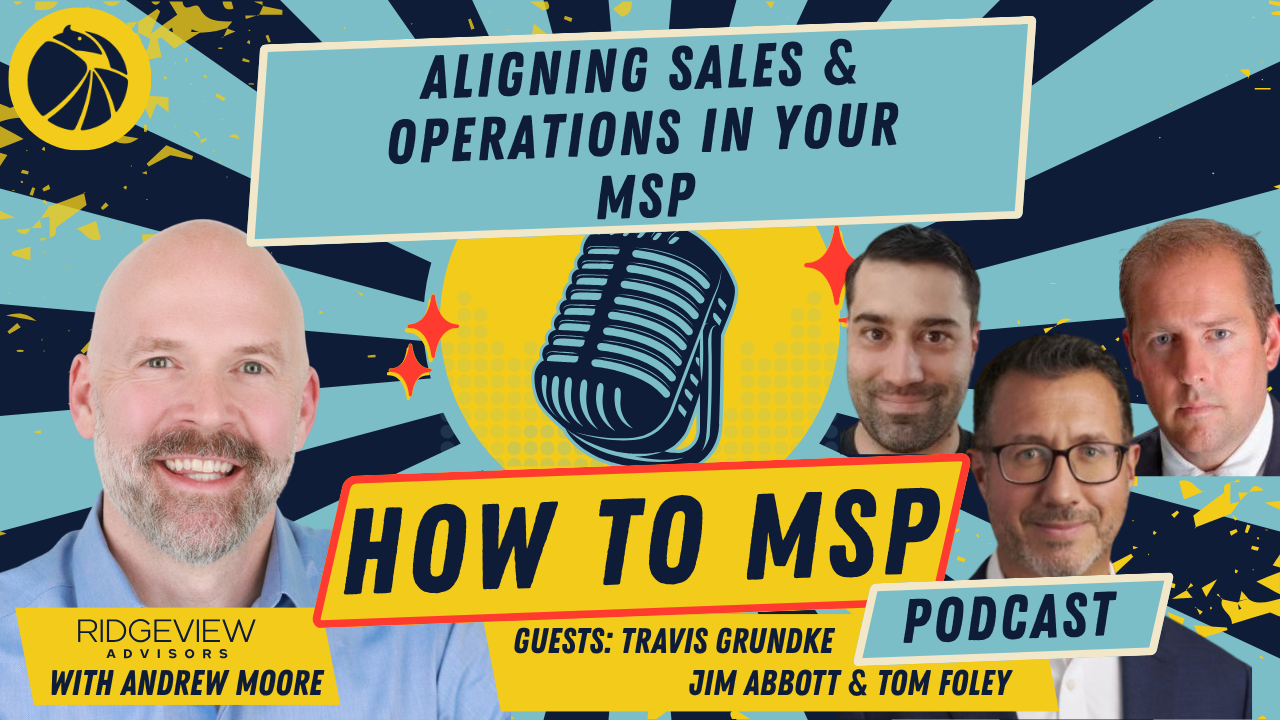
How to MSP© Podcast · Episode 8
The MSP Engine: Aligning Sales and Operations for High-Margin Growth
Ashton Solutions' leadership on aligning sales and operations into one MSP engine that protects margin, sets client expectations, and lets you say no to bad deals.
Watch
Listen
Subscribe on How to MSP© Podcast.
What separates a profitable MSP from a stressed one is whether sales and operations run as a single engine. In this episode of the How to MSP© Podcast, host Andrew Moore sits down with the leadership team from Ashton Solutions (opens in a new tab), an Ohio managed services provider Andrew has known for over a decade: Travis Grundke (Executive Vice President), Jim Abbott (VP of Client Solutions), and Tom Foley (Project Coordinator). Over two decades they built an MSP engine that protects gross margin, sets client expectations before a contract is signed, and gives operations the room to say no to bad business.
The thread running through the whole conversation is expectations. Ashton tells prospects what a remediation project will cost them emotionally and financially before any paperwork is signed, and Travis puts it bluntly.
“We are very clear about telling them that during the onboarding, we’re going to go through these things that we know about and these things that you’ve told me you don’t know about, but we need to find out about. And we tell them before we go signing contracts … there’s going to be a remediation project. I don’t know if it’s a $5,000 project or a $50,000 project. But you’re going to have a remediation project. Make your peace with whatever God you may or may not believe in. It’s happening.”
- Travis Grundke, 0:06
What you’ll take away
- Why telling prospects about remediation projects before they sign protects both trust and margin.
- How to move from owner-led selling to a process-driven sales engine using an ideal client profile.
- Why a roughly 90-line intake spreadsheet and two clean handoffs keep sales, onboarding, and service aligned.
- How viewing your contracts as risk management (the MSP as an actuary) changes which deals you accept.
- Why a strong pipeline is what actually lets operations push back, hold standards, and fire bad clients.
- How to keep account management inside operations so trust, not commission, drives the client relationship.
Sales is 80% process, 20% magic
Owner-led selling is where most MSPs start, and it is the hardest habit to scale past. Andrew frames the maturity step as aligning what you sell with what you actually deliver, and Jim Abbott, a self-described sales guy who admits he hates process, agrees that the network and the gut feel only carry a firm so far. Ashton worked with an EOS consultancy to build out an ideal client profile, talking points, and battle cards, which changed how often operations has to get involved at all.
“The number of opportunities that the sales team has that they feel the need to bring me into has decreased dramatically because they have built out the talking points, they’ve built out the battle cards … because of EOS, we’ve gotten very good at saying no. So by defining what we are not going to support, that’s helped narrow the focus quite a bit.”
- Travis Grundke, 12:43
That discipline is the same operating logic behind a healthy accountability flywheel: define the seat, define the standard, and let the team hold it. The payoff shows up in the numbers. Service Leadership’s 2025 profitability research (opens in a new tab) (ConnectWise, 2024 data) found that the highest operational-maturity providers run roughly three times the EBITDA margin of their median peers, and a defined sales process is part of that maturity.
The MSP as an actuary: managing risk and pricing it
Ashton treats a managed services contract the way an insurer treats a policy: a monthly premium set against the risk of the environment under management. That framing is why the onboarding standard is fixed at six weeks and why the intake process is so structured. Tom Foley built an intake spreadsheet of about 90 line items that the sales team fills out during qualification, so the onboarding team is not blindsided. Two formal handoffs, sales to onboarding and onboarding to service, keep the client experience consistent.
Tom’s standard is the part most MSPs underprice.
“Our goal at the end of the onboarding is that from day one we are able to provide you with the same level of service as a client that we’ve been providing your clients who have been with Ashton for 20 years.”
- Tom Foley, 34:04
Surfacing problems honestly is what turns a messy environment into billable, welcomed project work rather than service-desk noise, which is the same trust mechanic behind doing what you sell and the standardized service catalog that keeps customization from becoming bespoke.
A strong pipeline is what lets operations say no
The most useful idea in the episode is that margin discipline is downstream of pipeline confidence. When every dollar feels load-bearing, an MSP accepts abuse and absorbs bad environments. Ashton fired a belligerent client mid-contract because the pipeline made walking away affordable, which freed the engineering team to serve clients who actually grow revenue.
“We’ve learned over the years and we have worked very, very hard as a team to put ourselves in a situation where we don’t have to eat shit.”
- Travis Grundke, 55:08
Keeping client account management inside operations rather than sales is the other half of that retention engine, the same reason a deliberate hire like your first service manager pays off: the person managing the relationship is trusted because they are not selling. On AI, the team’s view is grounded. Strip the busy work off engineers so they spend more time with clients, and judge the work by client outcomes rather than checkboxes.
Mentioned in this episode
- Guests: Travis Grundke (LinkedIn (opens in a new tab)), Jim Abbott, and Tom Foley of Ashton Solutions (opens in a new tab) (company LinkedIn (opens in a new tab))
- Book: The Goal by Eliyahu Goldratt (opens in a new tab)
- Book: Unreasonable Hospitality by Will Guidara (opens in a new tab)
- Book: The Medici Effect by Frans Johansson (opens in a new tab)
- Music mentioned: Bad Religion, Travis, The Midnight, and Tyler Lyle
About the guest
Travis Grundke is Executive Vice President of Ashton Solutions, where he acts as the senior operations and business advisor across the companies on their MSP platform. He brings more than two decades of experience integrating people and technology to solve complex business problems. He is joined on this episode by Jim Abbott, VP of Client Solutions, who leads business development and marketing, and Tom Foley, Project Coordinator, who runs onboarding and project delivery.
Chapters & timestamps
- 00:00 The reality of remediation projects
- 02:00 Meet the Ashton Solutions team
- 04:15 The credibility pack: polishing your sales process
- 07:23 When a sales guy says no to a prospect
- 09:32 Building a scalable sales process with CRM
- 13:40 The EOS approach: finding the ideal client profile
- 16:25 Selling business solutions vs. technical weeds
- 20:57 Why size does not dictate complexity
- 24:48 Managing risk: the MSP as an actuary
- 31:00 The six-week onboarding rule
- 38:45 Changing tires while the car is rolling
- 43:30 The art of firing belligerent clients
- 51:46 How a strong pipeline empowers operations
- 1:03:41 AI: cutting through the hype to find outcomes
- 1:08:26 Five questions: books, music, and interview horror stories
Transcript
The full transcript is on the page (crawlable for search), collapsed for readability.
Read the full transcript
Travis Grundke (00:06): the one thing that Abbott talks about is setting expectations upfront. And we are very clear about telling them that during the onboarding, we're going to go through these things that we know about and these things that you've told me you don't know about, but we need to find out about. And we tell them before we go signing contracts, hey guys, we're going to come back to you. And since no one knows anything about this email environment, there's going to be a remediation project. I don't know if it's a $5,000 project or a $50,000 project. But you're going to have a remediation project. Make your peace with whatever God you may or may not believe in. It's happening.
Andrew Moore (00:42): That was Travis Grunke of Ashton Solutions out of Ohio. They're a managed services provider that has found a way to align sales and operations in such a way that they've created a dynamic MSP engine for their community. Today we talk with Jim Abbott and we also talk with Tom Foley with Travis and his team about how they align sales, operations, account management, and what that means for onboarding, setting expectations with your clients. and what a powerful pipeline does for the ability of operations to be able to create gross margin and set boundaries with their clients.
Andrew Moore (01:21): All right. Hello and welcome to the how to MSP podcast. My name is Andrew Moore and I am the host of the show today. Every day, I guess. so I am really excited today about our show because we are talking to the folks at Ashton technology solutions out of Ohio. They are a fabulous MSP. I have known them for over a decade.
Andrew Moore (01:48): a long time. Travis and I have been in operations peer groups together and had a lot of good times, some stories, something that maybe never see the light of day, some that we might be able to recount, but a lot of good times. So I'm really excited that you guys are here today. Welcome to the show.
Travis Grundke (02:09): Thanks for having us.
Jim Abbott (02:09): Thanks for having us.
Andrew Moore (02:11): Yep, absolutely. So today we've got Travis, Jim and Tom, and they are with Ashton and I'll just quickly kind of go through the team here and have them introduce ourselves. Travis, let's start with you. What's your role? What do do?
Travis Grundke (02:25): Sure. So I've been with Ashton now for, I want to say 23 years. And I am currently executive vice president. So I kind of run the operations. If we're doing EOS speak, I'm the, technically I'm the company integrator.
Andrew Moore (02:41): Excellent. And you've got a background in technology and ish. Yeah. Yeah. Yeah. You know enough to know that if somebody tells you something in an acronym, you can actually. Yeah. Love that. Love that. And Tom, what's your what's your role with Ashton?
Travis Grundke (02:44): Ish, adjacent, ish. Yeah. The sniff test, yes.
Tom (02:59): I am the project coordinator here in Aspen. I've been here for seven years. So I help clients with the projects that we're doing, server migrations, hardware replacements, but our big focus right now is onboardings and bringing on new clients. Yeah.
Andrew Moore (03:16): onboardings. Like company onboardings. Yeah, client onboardings. Okay. Awesome. And Jim, hi, buddy. What would you say you do at Ashton? What are you up to these days?
Jim Abbott (03:29): The business card says VP of Client Solutions and that's only because a prospect many years ago was offended that they didn't have a VP sitting in their office. So sales and marketing is what I really do regardless of what the title says. A lot of biz dev and a lot of marketing.
Andrew Moore (03:46): Yeah. And I will be 100 % with the channel. There have been plenty of really great sales and marketing things that I've stolen from I asked him if I could have them. Yeah. Yeah. Yeah. We borrow There's a little, there's a little borrow Yeah. A little bit of borrowing collaboration, if you will. So he's, his stuff works great. It's a matter of fact, my wife's company was talking to me, I don't know, a few months ago, I've been kind of helping them out with some sales stuff and they're putting together a credibility pack and they were like show me what you did with iron edge and I was like and so I got out the credibility pack like you guys had built with all the different flyers in it and everything they're they're very excited to start trying to figure out how to put something like that together so it lives on it lives on
Travis Grundke (04:28): What version of that are we on now, Abby?
Jim Abbott (04:30): Version 4, version 5, 12 years in, 13 years in. That actually preceded me. So I can't take credit for it. The original anyhow.
Andrew Moore (04:33): Well, it was solid whenever I saw you guys, whatever version I got from you was fantastic. So I've been for those who who aren't familiar with what we're talking about. had the Ashton team had put together like a folder with a branded branded folder. And when you opened it up inside, there were flyers, which, you know, seems like it's pretty standard stuff, but they were kind of staggered in such a way that you could see different things, the different solutions that they would offer. And you could mix and match things out of the folder. And it was really beautiful and well presented and it made them look like a very well put together MSP in the sales process. I attribute having borrowed that idea and used it in our sales process of having to help us win many accounts because of it really representing us as being a more polished MSP when we were in the process of trying to build that trust at the beginning of the relationship.
Jim Abbott (05:29): I actually see the bright green folder sitting over Travis's left shoulder.
Andrew Moore (05:34): there it is.
Jim Abbott (05:35): We know that when we hand those out, it's going to sit on somebody's desk. And I think your theory, Andrew, was IT emergency. Put a tab on it, put it in a PendaFlex folder. We know that it's going to stick out like a sore thumb. And when somebody has a problem, we're going to be there for them.
Andrew Moore (05:52): Yep. No, I love that. I love that. but I feel like you guys really were one of the first MSPs I talked to at your size that cracked the nut on how to really create alignment between sales and operations. And I'm just saying, like I know it.
Tom (06:08): We don't have to agree on everything all the time, but yeah, we do work pretty well.
Andrew Moore (06:13): guys like honestly it to me when you talk about sales and and operations alignment the goal is to try it like in our space people come from owner led selling In EOS, you've got the integrator and then you've got the visionary. And a lot of the times, the visionary is the one that's out selling because they're really excited about the business. And when you're the visionary, you're not thinking about what it's going to mean when the integrator or somebody else has to actually do the work. You're just trying to close the deal. And I think that's the real maturity step for an MSP is to start aligning what it is that you're selling with what you actually do and what goes on in the contracts. So I guess I'll start with, I'll start with you, Jim. Like where do you see sales and marketing in that sort of process as you're trying to develop these relationships and open up opportunities and sell into new accounts? Why do you even care what Travis and the team are supposed to get knocked out? Like why, why, why does it, why does it matter to you if you're out trying to get a sale? Like just get it, let's like root into the very basics of it. Like why do you care?
Jim Abbott (07:23): So I'll tell you the first time that I ever, Travis and I sat in a prospect meeting and small manufacturing firm, prospect kept answering questions the wrong way and I finally closed my notebook about 15 minutes into the meeting and put my pen down and thought this guy is just not a good fit and Travis practically fell off of his chair. for me to say, no, you're not a good fit. And at this point, the prospect kind of begged us, please don't go, I really want to work with you. And I'm like, you're just not a good fit. So I learned my lesson. That was about probably eight years back. I still can see the look on Travis's face when I actually said no to somebody. Sales guys always want to say yes. that doesn't make, and that's not just MSP. I worked for a web design digital marketing firm before this. operations had the same issue with me that they thought I always wanted to say yes. As much as I hate process, being a typical sales guy, you do have to say no and you have to find what the right fit is and understand that I can sell all day long, but if our team can't back up what I'm selling, it just makes everybody look bad. It's not a good customer interaction and the words are going to get out.
Andrew Moore (08:44): Yeah, for sure. And I want to I want to poke on something that you just you just said there. You said it's a process. And I preach to people who come to me and say, I need help with sales. I'm like, great. So I'll say, so where are you tracking your opportunities? Like, how are you doing your call downs? What does your day look like when you're scheduling stuff? You know, what you know, how are you qualifying? What process are you using? Right. Like. And a lot of them are just like, well, no, I just, need more leads. And I'm like, I come back and say, I think we need to build a process first because I feel like sales is 80 % process, 20 % magic. Because I think there's still some magic in it. I don't know, what do you think? You think I'm wrong?
Jim Abbott (09:32): I would agree. mean, there's definitely process to it and we have a great sales team in place now who is much more process driven than I am. They're great at using the CRMs. Glasshive, previous, now we've just moved to HubSpot, which is going to give us even more eyes on, better analytics, better credibility. I hate process and that's my rock for the year is to follow process and everybody on the leadership team has told me I need to do that. you know, I know it's there. It's like pulling teeth. You know, everything I do is in my head and I realize that's not scalable. So I am fortunate that the sales team we have in place now is very much about using the CRM, about a process, phone call, email, follow up, follow through, knocking on doors, talking to people. I just go out and shake hands and kiss babies. And fortunately, I have a very good network in place. But again, a network is not scalable. So you have to have that process.
Andrew Moore (10:35): Yeah. And then when your process is working, how do you work with Travis and Tom and the rest of the team to integrate them into that? You said you went to a client, you went to a prospect with Travis. How do you integrate operations into what you do? If at all, what do you do there?
Jim Abbott (10:58): So I'll often bring Travis along, any of us on the sales team will bring Travis along if we realize that somebody wants to get down into the technical weeds. As sales guys, I think we were all born without whichever side of the brain it is handles technology and science and detail. So we can kind of tell early on if somebody has an in-house IT resource, okay, they're gonna wanna get down into the technical weeds. We're much better off bringing Travis, bringing one of the senior engineers in to talk that talk. I also think it's, I mentioned to a prospect the other day that I understand they don't always want to hear from the sales guy because they look at us as we're trying to sell them. It's important to have somebody who isn't selling inherently. Same goes for existing clients. They would rather hear from client account management or engineers as opposed to me and my team saying, you need 10 new PCs. They just look at we're trying to sell and up the bottom line.
Andrew Moore (11:56): one of the next things that I really want to poke into is as you bring Travis or someone along for the sales engagement, Travis, how does how does that play for you? Do you feel like you're adding value to that process? Do you feel like I know that in the past? when that would happen with me, sometimes I felt like maybe I was too involved in the sales process and maybe my sales team wasn't really being as utilized as I probably could have had them because I just, knew how to close a deal. I knew how to get in there and talk to the client. I knew what they wanted. Is that the same for you? Are you more involved, less involved? How does that work? What's the balance between you and Jim and the team when it comes to selling and operations?
Travis Grundke (12:43): So couple things. First of all, this will be, believe it or not, kudos to Jim Abbott for putting the process in where it needs to be. The number of opportunities that the sales team has that they feel the need to bring me into has decreased dramatically because they have built out the talking points, they've built out the battle cards, all that kind of stuff that needs to be discussed. Most importantly, They understand that the majority of the clients that we're talking to right now, they're not interested in technical discussions. They're looking to solve a business problem. And they're all very good at talking about solving business problems. So because Jim's been able to build this stuff out, and as a sidebar, we worked with an EOS company called Convergo a few years ago to help us build out the sales process. So what's the ideal client profile? Who do we go after? Why do we go after them? What are the talking points? What demographics are there? What are the questions around that we should be asking? So Jim and the sales team have built that out. So that's a long way of saying the good news is they've got a system in place that only requires the technical team when there's really a need to kind of close the deal for some technical reason of a sort. So my involvement has decreased dramatically, which. is great because it's a testament to the sales team for building that out. The other thing though that has changed that's allowed them to do that is, again, because of EOS, we've gotten very good at saying no. So by defining what we are not going to support, that's helped narrow the focus quite a bit. So we cut out a lot of junk. And over the last two, three years, we've really become hyper-focused on the ideal client. You know, just because it's business doesn't mean it's good business. And so we've been cutting that out. So my involvement really has dwindled because I used to be Dr. No. You know, the sales team at Avid would come in say, hey, I talked to this guy. Here's what they got. Da, da, da, da, da. And I'd look at them and say, no. And that was my job. And you're, no, but they're going to be a center of influence. Or they're going to introduce us to all these other people. Or if we get in and we just do this survey, then they're gonna have us do managed services and Jim's laughing and all.
Jim Abbott (15:10): And I still do that on occasion
Travis Grundke (15:12): Right, and there's still some of those opportunities that come up that are legitimately good ones, but we're not chasing phantoms anymore. And we get to know faster, thank you, that's exactly right.
Jim Abbott (15:19): We get to know faster.
Andrew Moore (15:24): Can I poke in on that for just a second? I wanna talk about getting to know. One of the things that I think is really important for a sales team is that beginning qualification process before the discovery call. So there's a thing that I want to ask about how you guys operate together with operations and it comes back to getting to know. First of all, it's more of a two part question. Are you all involving the operations team? as part of the initial discovery process, does somebody come out and look at the environment on your behalf and scan things, or is that done by the salesperson? And if you do bring in somebody from operations, how do you make sure that you're not wasting their time because you didn't qualify them properly? Can we dig into that process between sales and ops and talk about how you guys do it what you recommend?
Jim Abbott (16:13): So oftentimes the people we're speaking with don't, they're not here to talk about firewall switches servers. They have a business issue. They've had a breach, a data exfil. Their current provider is not reacting quickly enough, resolving quickly enough. They're not bringing any strategy to the table, any insight. They're just a wrench turner, very reactive. So as Travis says, it's less and less frequent where we actually need to get eyes on the network, the hardware, the systems to make a decision. In those instances, when we do, I typically rely on Travis. It's much easier to pull him out than it is pulling Tom or one of the engineers who's working on a project off. That's been kind of hammered into us. Hey, don't bother the smart guys in the building. Let's get Travis involved. And Travis is great because he can speak to technology, having been there, done that, but he can also speak to the business perspective of things. As I say more and more, we're talking business with people. We're not so much talking technology.
Andrew Moore (17:30): Right. But if you do wind up, like if you have to bring in Travis, how Travis, how often have you over the years been brought into a deal that was just not qualified well? Like, are y'all getting better at that? Are you, you know, we're.
Jim Abbott (17:46): We've gotten much we've gotten significantly better over the years I mean it used to be I was that every time I spoke to a prospect Initial phone call I'd wander down to track, you know, I'd shoot him an email and I'd wander down to his office thinking I'd beat the email to his office Hey here all the exactly here all the details. What do you think? You know, it's me being the sales guy sure we can sell this we can do this Part of that is because I have so much faith in the team we have put together. I know these guys can get the job done and do it the right way, which makes it easy for me to sell, makes it easy for our team to sell. But I think we've really reduced those bad opportunities significantly in recent years.
Travis Grundke (18:31): So it's a, you Andrew, you remember this, because you've been through the MSP space from small to large and the growth phases. It's a maturity curve. And when you're smaller and younger and an immature business, you just kind of take all comers. To be honest, I don't remember. Tom, maybe you could jump in on this one. I can't remember a recent opportunity where we went in and did a technical analysis before signing paperwork. It was basically, and that's a way of saying, along the lines of what Jim Abbott just mentioned about, we're talking business, most of the conversations, the environments now, they're moving from an existing provider. It's not like they're starting from scratch and have never had an outsourced IT vendor. So that's changed. A lot of the environment now is cloud-based. So they've got a Microsoft 365 environment. They probably have a firewall. They've got endpoint security. They've got a couple of line of business applications. And really all I care about at this point is how many laptops, desktops, servers, firewall switches, locations do they have? Because we know we're going to go through and review all that shit. and we're gonna clean it all up anyhow, and we're gonna have to recommend replacements. So depending on the size, we're walking into a 500-seat environment, yeah, we're gonna do the technical dive. If we're walking into a 50-seat environment anymore, generally it's a, do you have an asset report that shows me age of hardware, and that's good enough. Because we're probably gonna recommend ripping and replacing a bunch of stuff anyhow, and increasingly, we're just putting our own stack in, in terms of firewalls or any other hardware. because it's relatively inexpensive enough and it's cheaper in the long run for us.
Andrew Moore (20:19): Well, let's dive into that with Tom then. So Tom, how does that work for your team? Because you're actually doing all of the onboardings for the clients. What does that look like for y'all? Because I'm hearing this, and what I'll say is that that really puts a lot of what the MSP space is doing on notice. Because most people will want to do, most MSPs are going to want to do some sort of technical due diligence prior to taking on an account. How have you seen that mature within Ashton Tom? Like how does that work for you guys when you bring in an account that you don't have a technical review of prior to onboarding?
Tom (20:57): you know, years ago, would be scary. Like Abbott or someone on the sales team would come to us and say, Hey, we're onboarding this new client and here's everything we've got. And we're like, that, that just seems like a bad fit from the rip, you know, all of this equipment that they have, but the environment itself isn't really as much of a concern for us as fit. And I think, being able to lean on those processes that we have is what's really important because. I harp on process a lot. I know Abbot is probably sick of it at this point. But one of the first things I did as a project coordinator is I met with him and I was like, I want to understand your process because it doesn't matter what firewalls they have. It doesn't matter what switches they have or how many servers. What really matters is when my team gets in there and they start digging into that environment and pointing out and know, shining a flashlight on the things that are fundamentally wrong with how they are currently set up and how we want to improve that for them to make things better and make things more secure. It's is that client going to be open to those changes? Are they going to actually take us seriously and make those changes at the end? If they are, then the environment doesn't really matter. Because we can get in there. I know my team can get in there and fix it. I know my team can get in there and handle it. But when we get a client and Abbott goes, yeah, they have a Linux server and they said they have to have PuTTY installed on every single machine to get to it. And you can't run anything newer than the version of PuTTY that's 12 years old. Are they willing to make changes and improve that environment? No. OK, then why are we even signing them? Don't. There's no point. Yep.
Andrew Moore (22:46): Right. That's when Travis is like, no.
Jim Abbott (22:51): And that kind of comes with my experience. I came here having no technology experience or background whatsoever. And when Jim Millican, president of the company offered me the opportunity or we were having conversations, I said, listen, I don't know anything about this and I definitely can't talk to IT people. We just don't have anything in common. I don't speak their language. They don't speak my language. And he said, I don't need you talking to those guys. Just get your foot in the door, figure out what experts to bring in and we'll go from there. But over 12 years, I've gotten better. I can actually have a conversation with somebody about a firewall or how a switch works. And I know when somebody says, yeah, we're all on Linux, that's not a good fit. Or we're running an email solution because it's free. I think that was the guy I closed my notebook on. He said, yeah, we use this free email solution. Okay, you're not the right fit. See ya.
Andrew Moore (23:47): Well, I so I, I want to I want to keep going down this path a little bit because I wonder how you approach Travis brought something to my attention many, many years ago and I still use this term. I love it. He said that you guys used to keep office space near like an insurance company or something that did like pet insurance, right? Or something. And They talk to you, this light bulb went off for me when you talk to me about it, that what you do is, what we do as an MSP is risk management. And that by looking at contracts and discussing what the client needs, it's actuarial work, right? Like what is our risk versus our payment every month in order to maintain profitability, the portfolio of the assets that were under management by our company. So my question to you is, as the custodians of this these environments and you go in and you sell them something for a certain price and then Tom gets in there and he's like, this is actually a jacked up mess. How do you work that out with the client so that they're willing to spend the money to fix those problems or accepting the fact that you just jack their rate by 200 % in order to maintain your, your insurance on their environment? How do you guys manage that process with, with prospects?
Jim Abbott (25:13): I'm gonna start off on this and I know Tom will have an answer and Travis will have an answer, but it starts with sales. It's all about building trust. I think most people who are coming to us looking to make a change for one reason or another, oftentimes realize that they've got a shit show throughout their building, throughout their company in terms of technology. So they know that they're gonna have to make some changes. Once we get them onboard and part of the onboarding process is Tom and his team going through and scoping out, hey, you have issues here. Abbott tells me that you're concerned about your phone system. Abbott tells me you're concerned about. you know, five different servers from five different organizations that you've acquired in the past three years and you're trying to consolidate these five businesses under one roof. So Tom has a little bit of insight, but we have to build that trust. Tom and his team continue to build that trust. And by the time they have been onboarded and they're a month or two into the engagement, they're basically doing what we're recommending. mean, it's not a hundred percent of the time, but in most cases, our clients trust us enough where when we say, you need to do this and here's why you need to do it and it's not coming from me, it's not coming from the sales team, it's coming from the engineers with a business perspective to it, clients go, okay, we trust you, let's do it.
Travis Grundke (26:41): So, Andrew, to your point about how do you surface that stuff during the sales process, generally what's happened is because the sales team has built out a good set of questions and processes. Jim Abbott will have that initial conversation. He'll come back to me and he'll tell me, hey, here's what we found. Here's what we talked about. My first question is, do they have an asset list? He'll show me the asset list if they have it and I'll skim it and go, OK, red flag, red flag, red flag. I think you guys need to go back and find out what their willingness is to replace these things or move from on-prem to cloud or whatever it might be. Jim will go back and he'll have those conversations the second time through. And they generally tend to be more around like you talked about, a little bit more of a psychodemographic conversation. Hey, how do you guys like to invest in things? Andrew, this will go back to something too that we've talked about over the years. You remember this. You'd walk into a prospect and you could almost immediately tell from the foyer or the waiting room whether or not it was going to be worth your time or not. Because, yeah.
Andrew Moore (27:48): Spider sense, dude. That's what we call it, spider sense.
Travis Grundke (27:50): You could walk in and go, you know, if you, if you step in and it's 1970 with wood paneling and green shag carpeting, probably not going to invest in their IT, right? And Abbott's gotten good about developing that skill and teaching the other salespeople that skill. So to his point, when that does make its way over to the sales team, the one thing that, that I talk about when I get pulled in, the one thing that Abbott talks about is setting expectations upfront. And we are very clear about telling them that during the onboarding, we're going to go through these things that we know about and these things that you've told me you don't know about, but we need to find out about. And we tell them before we go signing contracts, hey guys, we're going to come back to you. And since no one knows anything about this email environment, there's going to be a remediation project. I don't know if it's a $5,000 project or a $50,000 project. But you're going to have a remediation project. Make your peace with whatever God you may or may not believe in. It's happening. And we'll go through those things that we know about. And as long as during that sales process they go, yeah, we know we have to do that. We're ready to make this move. We just need to get it fixed. As Abbott and Tom have said, once we get to the onboarding and Tom goes, yep, your 365 environments are wide open to the world and it's a $10,000 remediation, they're generally good with it. It's a risk. No doubt. It's a risk.
Andrew Moore (29:16): Well, Tom, it is. so I'm going to ask Tom, is that actually what happens? How does it go down in real life, like when you're actually poking around in those environments?
Tom (29:29): No. So there is a lot less swearing involved than there used to be. But it's because we've learned how to collaborate better. When I first started leading onboardings before I took over all of project management, sales very much had the thing that they did. They had their system for how they were going to sell somebody. They had their own set of documentation that was built out for them, and they would share that with us when they hand the client over for the onboarding once the agreement is signed. But I'd get that documentation. I look at it like, this is, this is useless for our team. There's nothing in here other than they have, you know, a firewall, a couple of switches, two servers and 20 endpoints. Like great. That doesn't really tell me anything about their environment. It tells me the size of the environment, but One thing we've known for a long time as size does not dictate complexity. You know, you could have a 500 endpoint client that is the easiest client to work with and a 20 endpoint client that is the most difficult onboarding you've ever had. and it was opening that door and talking to Abbott and saying, you know, this documentation is great. However, here's kind of what my team's looking for when you're having these discussions. And I know you may not. understand the questions you may not have, you know, understand if the answer that they're giving you is the correct one. But this is what we'd like you to ask. This is what we're looking for. If you can find out X, Y, and Z, that will help my team understand what we're getting into during the onboarding before we actually step into that environment and go, my God, this is a disaster. Like we kind of have a little bit of expectation there before the onboarding begins, and it just makes things go smoother.
Jim Abbott (31:24): So, Tom put together, I used to put together an initial conversation sheet, which was one page, just kind of anecdotal evidence that I picked up during the course of the conversation. And Tom put together a spreadsheet. mean, there must be 90 different line items on it that he has asked us, sales team, to gather that information. Now, I would say three quarters of it we can gather during the sales process. One quarter of it is left to the onboarding team to pick up as they start their process. But I think it's made it much more enlightening for our team to get that information. We ensure that there are no surprises for the onboarding team. Like, hey, they have three different locations and we only told you about two because we forgot one. And that's a big oops. So now that we've got prompts, so to speak, It makes it easier on us. makes it easier on the onboarding team, and it makes it easier on the rest of the engineering team throughout the course of the engagement.
Andrew Moore (32:33): Well, the thing that I do want to touch base on as we're walking through this process is, so now we've got to the point where they've signed contracts, Tom's looked at their stuff. We know that there's some things that need to be taken care of. However, the client is in operations. We are taking tickets. We have now identified projects. So the two things that I want to dig into is how does your service desk deal with what could be a misconfigured or messy client on the service desk? Are you absorbing that noise? Do you have any stopcaps or to put in place there is my first question. My second question is who gets commissioned on the projects that you sell after they become a client? Right. Is that your account management teams? Yeah. OK. So is the sales team involved? Like how does that so let's let's I'm going to dive into both of those things. Let's start with how do you deal with the ticket volume? What does it look like when you bring on a new client? Do you keep them isolated? Did they go right into regular production? Like what does that look like?
Jim Abbott (33:17): It ain't me.
Tom (33:18): Not me.
Andrew Moore (33:33): based on the fact that you've got a client that isn't optimized for the service desk. How does that look, Trav?
Travis Grundke (33:40): Well, so Tom, I think it might be better for you to handle this one in terms of how you're handling that right now when you come across these projects, because you and I have talked about this very recently in terms of a change in your philosophy on how we remediate or send a project. And then we can talk about how we do the project side of things. So Tom, you want to field that one?
Tom (34:04): Yeah, I mean, so to answer your first question, we don't silo them when they start. Everything that we've done on the project side, especially for onboardings, goes to the issues that we recognize. So there's two official handoffs. Sales does their prospecting thing and there is a handoff to the onboarding team. We do the onboarding and then there's a handoff to service. And both of those handoffs, we realized early on that We were kind of all doing things differently, you know, I'm process driven. So my side of the house, we have processes for everything and we, follow them as best as we can. Sales didn't really have a bunch of that and we didn't really understand what processes there were. So the client would meet with sales and they're like, this is one experience that they're getting. And then they meet with onboarding and it's like, okay, this is a little bit different. You guys are a little more, you know, They're a lot of fun and you guys are really serious. And then we hand them over. We hand them over to service and.
Jim Abbott (35:07): You can't give them the scary guys to start you have to give them the fun guys to start Suck them in with the fun and then give them to the scary guys
Tom (35:14): Yeah, you have to give them the fun guys. Yeah, I'm an acquired taste. get it. But then you hand them off to service. And it was a completely different experience because it goes back to being like, those guys are serious, but they're a little bit more relaxed. So what we really tried to do is identify
Jim Abbott (35:19): It's too late now, you've already signed the contract, buddy.
Tom (35:38): the issues between those hands-off handoffs and how we can smooth it out so that when we're handing off from one to the other, the transition is smooth, they're getting the same experience. And the onboarding team's goal is identify what's wrong with the environment, how we're going to fix it moving forward and let the service team know ahead of time. So. It's really that communication and that collaboration between departments that is making it easy for us. Because one of the things I tell the clients, we actually just had one talking about getting to know faster. I think the part that we kind of forget in that is it's not just yes or no, there's also maybes. So we had a client who came out, they wanted to start onboarding, they wanted to leave their provider, they had a recent compromise. And they came to us and they were asking specific things that according to my process for onboardings is not how we do things. and the sales guy came over and was like, Hey, listen, I'm prospecting this client right now. this is what they're asking for. If we're not able to provide it, then we're not going to be able to do it. And I told him, Hey, yeah, go ahead and tell them. Yes. Like we can handle that because we're just taking. A part of the process that happens towards the end of the onboarding and moving it to the beginning. And I can plan for that. I can coordinate that. I can let the team know what's happening and, and we can manage that. but I tell the client in the kickoff, cause one of the things they asked was, could you guys get this onboarding done in three weeks instead of six? And I'm very strict on it's a six week onboarding. Because our goal at the end of the onboarding is that from day one. we are able to provide you with the same level of service as a client that we've been providing your clients who have been with Ashton for 20 years.
Andrew Moore (37:39): I love that. I love the expectation, the ability to set that expectation for the sales team. I think it's fantastic too, because if they come to you and say, you know, like, Jim, I, I really need to get out of my contract. You know, it's coming up in like, you know, two weeks. Can you get me on boarded? The answer is six weeks, six weeks from contracts, right? Like, I mean, before I can start taking tickets.
Jim Abbott (38:00): what Travis refers to as changing the tires while the car goes rolling down the road. And there are instances where it has to happen. And I tell people on day one, the first conversation, here's how the onboarding process works. It's six weeks. If you sign on March 1st, you're going to be onboarded six weeks after. We'll start March 7th and it's April 20th. There are instances, and I tell them this, where we have to change the tires while the car's rolling down the road. You your existing provider says, screw you, I'm out. You're on your own. Or they choose to get out because it's become untenable. So if we have to do it, our team is good enough that they can do it, but it's much easier on everybody involved if that six-week process takes place as it is supposed to.
Travis Grundke (38:45): Let me give you two quick stories that feed into this. And the theme is expectations. So we've got a relatively new client that we brought on. And when we were in the sales process, we really liked the managing partner and one of the owners of the firm. Easy to work with. He told us, this was a great fit because he told us, here's my vision for the business. I'm going out and I'm acquiring and I want to roll these companies in. And I need Ash to be a partner in helping us to template this process. And he was very upfront with him on his timeline. And we were very clear with him on reasonable expectations. So one of the acquisitions that he made, the target company is staffed with some older staff and their legacy staff. And the owner of the new company has a new way of doing things. So there is internal friction that we have no control over. And on top of it, they're a seasonal business. So even though the owner of the company wants to integrate all these companies, get rid of the servers, move to the cloud, do all this kind of stuff, he knows that between now and June, we can't do that. And he knows that between now and June, it's going to be kind of messy from an IT support perspective. So the owner and us were on the same page in terms of, this is what we can do. These are the constraints we're under. And this is what your people need to be aware of. The missing piece there is we've run into some problems with their staff who have not been fully bought into the fact that, we need to make our piece that these things are going to be crappy for another six months, and it's not Ashton's fault. So we had a level setting, and this goes back to how do we communicate between sales, service, and client account. This week we had a level setting with them to say, you all need to educate your team to be a little bit more polite with us. more professional with us, understand that here's the list of constraints that we have. And we're doing the best that we can. We ask that you give us some grace until we can fix this all. Because guess what? When we fix this in six months, you're going to love it. But it's going to be bumpy until we get there. Once we set that, things seem to have smoothed out quite a bit. But it's setting those expectations very clearly and getting buy-in from the client. Then I think you avoid a lot of the headaches and frustrations. that a lot of MSPs have.
Andrew Moore (41:20): Well, I want to, I want to dig into, let's, let's, let's go back to the, the second part of that question. And then I want to dig into pipeline real quick. Cause I think pipeline is super important to all the conversations that we've been having today. So when we talk about migration to service after onboarding, so we're, know, now we're getting everything completely aligned. Tom, your team has found some projects. We kind of knew about them at, at sales. Now we're positive things are going to happen. and then you hand them to who within your organization and how do they manage that? Like what does that process look like and how do you continue to continue to build that trust with the client and drive that forward with whatever is happening in either operations or sales when it comes to the ongoing relationship?
Tom (42:08): So yeah, mean the onboarding for us ends with an onboarding report with all of the engineers finding and recommendations. And this is something that we're continuing to evolve for right now. But at the end of the onboarding, we have a meeting with the point of contacts. I have a report that I've generated that has everything that our engineers have found that. isn't what we would consider up to our standard in the environment and recommendations for how to improve that. Some of it is agreement services, things we're just going to change. We're going to work with you. My team's focus after the onboarding, because the guys that are on my team, they're engineers too. Like they're part of the service desk. I just pull from that pool of engineers whenever we have an onboarding. So some of the guys know what's going on with the client because they're in the onboarding. Some of them are learning about it towards the end. But we have that meeting. go over the issues that we found, the ways that we want to improve and the projects that we would like to scope out for them. And I just asked them on the call. say, listen, here's all of the tickets I'm going to create for things that we're just going to go in and fix. And if it's something we can fix without interrupting your users, we're going to do it. If it's something that's going to cause a disturbance, our team will reach out and consult with you first before making those changes so that we don't cause any unnecessary turbulence with your end users. And here's a list of projects we want to scope. This is why we're scoping the project. This is why it's a problem. I don't give them any kind of estimates or anything because I'm not the sales guy. I'm not scoping out the project as far as labor and things like that go. But these are the things we want to scope and it kind of an order of urgency. And do we have your authorization to send you a quote? Like, do you want to get a quote? Do you actually want to fix these things? And 99 % of clients that were onboarding, one, they're extremely generous when it comes to the report itself. We get a lot of comments on, you know, this is great. We didn't know that these were issues or, you know, vulnerabilities that. that we were facing. And most of them do want to do the work. There will be questions from time to time about cost. And I can give them rough estimates based on similar projects we've done. But usually, cost isn't the thing that we have to overcome. It's normally, well, this is going to be a big change for our users. It is. It is. It's going to be a big change. But we'll help you through that. We have documentation. We have guides. We have people on the staff who do training. so we'll, we'll help you through that. And I think the big thing with that is, we do set up expectations upfront sales and my team. but everything we do is also focused around building trust. And by the end of the onboarding, they trust us well enough to, to Travis's point, the client he was talking about the head and acquisition. The reason they left their previous provider is because their first acquisition, previous provider said they could handle it and they just didn't. And he was upset. And he came to us and said that and the onboarding ended within 45 days. He had purchased another company and about 45 days after that, this new company, we completely replaced every computer they had migrated them to a new phone system, migrated email to the, the parent tenant in 365.
Travis Grundke (45:44): So Andrew, let me jump on that because if this were. 5-7 years ago. What Tom just described? Could we have done it? Yeah. Should we have done it? Heck no.
Tom (45:55): replaced all of their network hardware and had them incorporated into this new company as well as we could without making huge fundamental changes.
Travis Grundke (46:25): I think it's one of those situations where if you look at it, I don't know your listener base and the other MSPs that will be watching this, but knowing where you are business maturity wise should drive the decision making process during sales as to whether or not you should be taking on this business. And we all know what it's like. Sometimes we eat the elephant and then we choke on it. We've taken some calculated risks over the years, but I think that's exactly what we've done is we have thought it through very carefully before saying, yes, we're willing to take on this risk. No, we're not ready to take on this risk. And I think there's a lot of business owners in the MSP space who just say, fuck it, let's do it, let's go.
Andrew Moore (47:11): Right. Well, who's managing the account and the risk after Tom gets done with it? You have an account management team, or is it somebody on the service desk? Who goes in and says, no, you do need to do these projects, and let's get these done, and let me do my business review with you, and make sure that you're on point? Who's managing that process for you guys?
Travis Grundke (47:24): So Laura Fisher is our client account manager, she often, she does kind of a tandem operation where she will bring in Tom because Laura can say to them, you need to do all this stuff. But Laura hasn't necessarily built up the trust that Tom has or any of the other engineers who've been intimately involved in the cleanup and the ombing and all that kind of stuff. So we really do, We operate on a team level to say, we're to go in as a team, Tom, Laura, sometimes me, to say to the client, OK, we've gotten through this. Here's why you need to take these next steps. That seems to be really effective for us because client account management for us, totally outside of the sales world on purpose. I go back to what you Tom Mitchell used to say this all the time is the reason why people bought from Tom Mitchell is because I'm not a salesperson. But when Tom says to them, hey, here's what you need to do, there's a level of trust that's been built up over time and he's not sales. He's doing it for the right reason, which is you need to do this.
Jim Abbott (48:52): And I'm doing it for the right reason, but the people don't necessarily think that because I'm the sales guy. I think along with that, we have a lot of people in the organization that come from a customer service type background. Whether it's, you I used to be on the phones with one of the top insurance carriers in the country, taking 150 phone calls a day from Customers and from agents, know, Tom was in retail. Francisco who handles procurement for us came from retail. Laura Fisher, client account manager, came from a customer service background. You know, in the end, we are a customer service organization. We just happen to be in technology and it's all about providing an outstanding customer experience. As I say, it starts with building trust. It's a ton of communication and you know, We want people to be happy and that's important. It allows us to stand out.
Andrew Moore (49:53): Yeah, I agree with you 100%. And I think that there are some scalability areas that I'd be happy to grab beers with you guys at some point and go through the different levels of how account management should work based on the size of your organization. But I do believe that at some point, that account management has to stay in operations. It needs to be there because I believe that account management really is that. the differentiator when you talk about service, Jim, it's like, we're a services company. And so if you make the relationship where the only touch point the client ever has is with somebody who is focused on cross-sell, upsell and project revenue, and that's how they make their money and their base is low and all those things like you can still get that out of a good operational account manager, right? And you can still incentivize those things, but the motivations are very different, right? And they're a very different type of person in my opinion.
Travis Grundke (50:50): And, you know, Andrew, you asked earlier, you know, how the comp model set up and everything else. The sales team is NetNew Logo. That's their comp model. And our client account manager is a salary position. It's not a incentive based seat at this point in time. That might change down the road. But right now it is, you know, that's just part of the job is to make sure that those requests get fulfilled.
Andrew Moore (51:16): Yeah. And I want to touch on something before we start winding down, because I think this is super important. And you had talked about the maturity of the organization or the size or the way that the processes within the MSP work and everything that you all are talking about. I don't think MSPs in general give themselves enough credit for how powerful a strong sales pipeline enables the operations team. Having the ability to push back, to say no on bad opportunities, to sit down and have a conversation with a client to say, you're being an asshole and I need you to chill out. Because you're willing to say, we have some pipeline. We're not desperate anymore. Can we talk about that a little bit? that, do you think about it in terms of that, or is that just a byproduct of having built this pipeline and now you're used to it? Like, how does that feel to you? Am I off base? I?
Travis Grundke (52:14): Hey Jim, can I jump in on that one first? So I You know, this is one of those I'm the old guy, you know, I've been in I've been doing this for long enough I remember back in the day and and I do remember when we were young and You know every bit of revenue mattered and there was that constant nagging fear of somebody turning off our lights. And so we would bend over backward, we would accept crap because we just felt like we had to. And to be candid, I think that in business, unless you get really, really lucky, there's a little bit of that that I think most small businesses have to deal with when you're starting. You just, you kind of do. But it's like the old adage, if you're the kind of person who doesn't understand that, know, and nevermind, I'm not gonna say that, but. It's the thought that if you want to improve your state in life, you got to do something about it and you got to bust your butt to get away from having to live like that. And we've done that through sheer will and some luck, but will and planning and process to get away from that. Quick example for you. Last year, we had a client for, we were in year, I think, I want to say we were going on year two of a three-year contract and the owner of the business was very belligerent and finally we'd had enough and we fired them as a client. Verbally abusive. And we fired them. I get a phone call a week before, we gave them six weeks notice, almost eight weeks notice. A week before the contract with us supposed to end I get a call from a competitor who says hi I'm Bob Smith calling from so-and-so MSP We're we're taking over for this company You know just wanted to you know get the process started and I said great You know what information have they given you and he said to me? I don't really know, I'm just the sales guy and I'm supposed to kick this off. I just sold the deal. And I said, do you know the reason why we walked away from this business? And he was like, man, I'll be honest with you, I really don't care. That was exactly what he said to me. He's like, I really don't care. They signed when I walked in to go talk them, they just signed. And I said, if you want to have an off the record conversation, I'm willing to give you some insight. And he was like, nah, that's not my, that's the operations guy. Literally, that's what he said to me. That's the operations team. They can deal with it. I'm just here to sell it. Okay. You do you.
Jim Abbott (55:05): Operations team is gonna love you.
Andrew Moore (55:07): That's the worst. That's the worst.
Travis Grundke (55:08): You do you. So my point is that I think that we've learned over the years and we have worked very, very hard as a team to put ourselves in a situation where we don't have to eat shit.
Andrew Moore (55:23): Yeah. Yeah. And I think that comes back to, I strongly believe that comes back to if you've got good account management and retention processes, your onboarding processes are solid. A lot of that comes back to, we doing the right thing on the sales side? if, you know, Jim's team is pulling in revenue at a clip that you're comfortable being able to say, listen, we don't have to sing for our supper though, that we used to, we've got a pipeline of qualified opportunities here. We can push back. We can feel comfortable about raising rates. We can feel comfortable about having conversations with clients who aren't doing the right things, right? We can, we can say no to the Linux account with all the putty instances on it, right? You can, there are things that you can do, but I think the empowerment comes from having a functional sales system and allows you in my opinion. not just from a revenue perspective, but from an actual like dollars in the bank. Like I think it allows the operations team to grow their margins if you're doing it right. Right. That's that's my opinion.
Jim Abbott (56:29): And that's a lot of what we're seeing. The pipeline will always be an issue. How do we get new leads into the pipeline? And that's a lot of the reason we went to HubSpot. to create a more automated marketing process. That's why we've added to the sales team in terms of bodies to get more people out, as I say, shaking hands, kissing babies, going to events. That said, the vast majority of our new logos are referrals and just our personal network. there's, again, that's not always scalable. And I don't think that's ever going to change from an existing client perspective. know, the manufacturer that Travis mentioned that we dumped last year, I don't get anything from, none of us get commission from contractor NOLS. You know, once they're in the door, we're out. So I don't care personally letting somebody go, but at the same time, from a business perspective, I look at it as revenues are going out the door. Now, We dump an asshole. We lose the revenues, but there's a lot less grief and agony for the engineering team. They can put their focus on people who appreciate what we do and who will continue to grow that revenue. There are other clients who we just grow out of. And they're not causing problems. They're paying their bills. They're not paying much. But when. when the rest of the team goes, let's just dump these guys. It's not benefiting us. My perspective, it's revenue. They're not causing us any problems. You're killing me, even though I don't get anything out of it. My goal is to increase revenue. That's the bottom line. Me and my team, we're here to increase revenue. And when we're dumping clients who might not be the optimal fit, it makes me sweat and makes me angry.
Andrew Moore (58:19): Yeah. Well, it's interesting. I had a conversation with Reed Warren with IT valuations. And one of the things that he and I talked about was this was surprising to me. I guess I shouldn't be surprised because I've kind of gone through the private equity world a little bit, but valuations are heavily skewed towards revenue growth. It's not just whether or not you have a certain amount of revenue and your gross margin is definitely important because that drives to your EBITDA. But if you can show year over year, revenue growth, top line revenue growth, then apparently that, you his position on it is, is that actually will increase your multiple because people will buy you knowing that they can probably fix suboptimal operations. But if you're out there in your market,
Jim Abbott (59:21): But if you're putting 5 % to the bottom line, who cares if your revenues are growing 25 % every year, but it's not profitable? From our perspective, private equity looks at it from a different perspective.
Andrew Moore (59:29): That's, that's fair. Right. For sure. If you're running your business, for sure. I just mean that it's important for that top line to your point, Jim, it's important for that top line revenue growth to continue to happen. Right. So if you're, if you're, if you want to run a lifestyle business and you want to run it $5 million at 25 % forever, and you never want to grow your top line revenue. Great. Like that's awesome. Like that's a way to run a business. And that's fantastic for everybody. If you want to grow your top line revenue, you should be focused on that rule of 40 and trying to align those, those two numbers on on your growth statistics, but also at the same time, it's really important for MSPs to realize if you're dumping clients off the backend faster than you're bringing revenue up on the top end, right? It's a problem. Even if you're running it 20, 25 % net, right? You're gonna be in a position where you're just gonna stay stagnant. That's a problem.
Travis Grundke (1:00:13): Well, and Andrew part of the part of the and I'm hearing this from a couple of colleagues that you and I both know as well as others that You know in general in our space the net new business Growth has slowed pretty dramatically and it's it's it's churn in terms of moving from MSP to MSP that we're Because most everybody's been through the MSP or they've got an MSP And so the net new growth has really become the biggest challenge I'm seeing a lot of people facing.
Andrew Moore (1:00:59): I'm hearing the same thing in the channel is that people are, it's, think people are still interested in bringing on an MSP, as they grow. think though that you're seeing a change in the buyer of our services and that you're coming into a generation of people who grew up on technology and are familiar with how that works. So you've got a different buyer persona versus you know, Gen Xers and boomers who were not quite as up to speed on how some of that stuff would work. so you've got that as a potential thing. You've also got the like low level of, in, of opportunity costs to get into a solution. If you want to start a business, you can go out and get an office 365 tenancy for 25 bucks a month versus before you'd have to buy a server and install software on it. So you've got a change there where they can run it kind of a lower level. So I think the MSP space is really going to have to have a conversation with itself about who we're selling to and what they actually want. And I don't think we're ready for that conversation. You're seeing it at the shows. I was at right of boom. You know, I've seen what happened at IT nation last year. You go onto the floor of those shows and it's 80 percent security vendors on security services to people still, which is a big deal. But at the same time, think we're lagging on that when it comes to new opportunity. You know, everybody's like now with AI. Well, there's only a couple of like pure AI companies that are a gentle agent based AI that are actually selling into the MSP space. You're only I'm only ever seeing a few like real innovative companies. I empath is one they're out there like selling learning management solutions to MSP. There's not a whole lot of companies that are out there that are really trying to address this because I don't, think we're going through this existential crisis within our industry where you've got companies that have been around forever, like Kinectwise and Datto, and they're being kind of looked at as slow and clunky and big. And you have new up and comers like Halo and Ninja and there's companies that are coming in and they're kind of shaking things up a little bit. And I think the next like five years within our industry is going to be a huge shift. And it has to do with exactly what you're talking about is what do our buyers want? and how are we gonna run our business? And by the way, AI, AI is coming for everybody. It's freaking me out a little bit. I don't know what you guys are seeing when it comes to AI with your clients. I just know that when I've talked to folks out in the market is that people don't know how to sell AI or even how to consult around it well enough in the MSP space to monetize it in any way. They're just like, it's weird and expensive and expensive to consult because nobody knows it.
Jim Abbott (1:03:41): Well. I agree with you on that for sure, but at the same time, the buyers, the prospects that we have, they're all talking about AI, but they don't know enough about it to know what questions to ask. I related a story this morning in our meeting that 12 years ago, I had lunch with a lawyer buddy and he pounded his fist on the table and said, Jimmy, I got to get my law firm in the cloud. I said, Rob, do you know what the cloud is? goes, nope, no idea, but all my peers are in the cloud and I've got to have my firm there. It's the same now. We've got to use AI. Well, what's your what business process are you trying to improve through AI? What are you trying to get to with AI and they go? I don't know. I just everybody talks about AI. We gotta be using it. OK, so they need to figure out what questions to ask. We need to do a better job understanding how we can use it both internally and externally, and we're doing some really cool things internally. Making. people's technology better for them through our use of it. We're allowing our engineers to spend more time focused on customers because we're getting the busy work off their plate. And that's huge, again, in a customer service organization. We can provide even better service because that's what our clients remember. They don't remember we turned a wrench and fixed something. They remember the time we spent with them.
Andrew Moore (1:05:09): Well, it comes back to what your core philosophy is around how you're running your business. You see yourself as a service company that's using technology as a way to provide service, but you're also understanding that you're focused on business outcomes. You're not as focused on, you know, Tom's team is obviously focused on the check boxes and the things that you do within the environments to make sure that they're configured properly. then the out like Tom, I believe Your team is successful because you know that you're driving towards an outcome, not that your job is just to make sure that that environment has this, this checkbox on it. You're like, well, if I check that box, this is what the outcome is for the client. I feel strongly that if you keep that philosophy, adoption of AI will probably be less difficult for you than it will for other MSPs because there's an upskilling that has to happen to people on Tom's team as we go into AI and you remove that busy work, they're going to have to get smarter and smarter about outcomes. And if that's already in the DNA of your company, I feel like you're in a better position to be successful long-term.
Travis Grundke (1:06:16): And that's exactly what we talked about this morning during our all hands meeting is how do we set ourselves up to be successful and not reactive to the trends that are occurring? you know, like we said earlier in this, where should we say yes and where should we say no? What do we need to shore up in terms of our skills and insight? And what do we need to partner? with other people to say, hey, we're not the right people to have this conversation with you, but I'd like to introduce you to Andrew who he's gonna be able to walk you through this and point you in the right direction. Perfectly happy to do that, because it's the right and responsible thing to do. So we're trying to figure out very quickly how to do that. And in the meantime, we're trying to build out internally, know, basic competence, responsible talking points, and. layering in the use of some of these solutions where it makes sense. I think that too many people look at the big pie in the sky and think, you know, it's gonna, we're gonna automate everything and no one's gonna have to work kind of thing. I'm more interested in what are the small little changes that can occur to improve people's lives and more importantly, give us more free time to spend time with people. Let's automate the tasks, spend more time with people. That's where we're driving.
Andrew Moore (1:07:42): No, I would agree with that 100%. Well, I'm call that a day when it comes to our conversation. I wanna thank y'all for being a part of what we were doing here. I think that it was incredibly insightful to hear about how you guys manage your clients and your processes when it comes to sales and operations. I respect the hell out of everybody there at Ashton and especially the three of you. So I appreciate you guys being here with me today. That being said, I'm gonna get into the five questions. We don't all have to answer each of them, so I'll just kind of throw them out and whoever wants to go for it will go for it. So let's start with, what's the best book you ever read that ever helped you in business? Anybody.
Jim Abbott (1:08:26): I'm gonna say I hate business books. I read a lot. hate business books. Travis, it seems once a month is throwing something on my desk. I'm a huge fan of Unreasonable Hospitality. It's about the food service industry. It's customer service and it's restaurants. but it pertains to people outside of the food service industry. The other one, because I've been around it all my life as I have been food, LL Bean, the making of an American icon. Amazing story about how LL Bean grew that business from making hunting shoes to what it is now.
Andrew Moore (1:09:02): Nice. Nice. And Trav, you've probably got one because I know that you like actually sneak off to remote places with a trunk full of books.
Travis Grundke (1:09:11): I know. Actually, probably the one that has stuck with me the most was The Goal, which probably came from you way back in the day. I'd be the last person to read that, if that were the case.
Andrew Moore (1:09:19): Dude, that's my favorite. That's my favorite.
Jim Abbott (1:09:21): Sounds like a hockey book.
Travis Grundke (1:09:29): No, was fantastic for getting me to realize that every system has constraints and to make my peace with God that they exist instead of trying to optimize for every little thing. So, yeah.
Andrew Moore (1:09:34): That's good. And I love the idea of I think the restaurant industry is a complete parallel to what we do. I grew up working in restaurants. It's just fascinating the amount of effort that goes in from, you know, your to your point, Travis, the throughput of how do you take reservations? How do you make sure that everybody's seated properly? What are your daily disciplines for managing your stations? Like how do you coordinate the front of the house in the back of the house? Like it's just amazing to me that these that these people figure out how this stuff works. And if you are a smart MSP owner, my opinion of it is do not try to reinvent the wheel. Go look at another industry that's been around for 100 years and just do what they do. Just copy whatever good restaurants are doing and then figure out how that applies to your business. Just real simple.
Tom (1:10:33): To that point, my favorite book is the Medici Effect, which people probably wouldn't consider a business book, but it's all about the intersectionality of ideas between different cultures and different concepts. So what in food industry could be applied to tech? What in sales could be applied to tech? It's actually about a banking family in Florence, Italy that basically funded the Renaissance movement by funding different projects for artists who are working with science, know, scientists and philosophers and things like that, and how true innovation comes from people with different backgrounds and different experiences coming together and finding where those overlap and, you know, new things that can grow from it.
Andrew Moore (1:11:27): That's fascinating. That's awesome. And for anyone who's interested, will put links to all these in the show notes. So we'll be able to find them quickly. all right. It's like Tourette's favorite, favorite curse word. Go ahead. Blurt it out.
Jim Abbott (1:11:44): Fuck.
Tom (1:11:44): I don't know that it's my favorite, probably the one I use the most is Motherfucker.
Jim Abbott (1:11:50): That's what he says to me when I bring on a bad opportunity.
Andrew Moore (1:11:50): There you go. There you go.
Travis Grundke (1:11:56): Huh, fuck.
Tom (1:11:56): It's usually when you leave my office and I just go, motherfucker.
Travis Grundke (1:12:00): In agreement, yep.
Jim Abbott (1:12:02): Travis's mother taught him well, he doesn't swear. She might be listening.
Andrew Moore (1:12:04): Sure. Yeah, well, we'll make sure you can send her this little bitty clip. You're like, Look, Mom, look what I did. I didn't say a bad word, everybody else said fuck.
Andrew Moore (1:12:14): All right, let's see. I'm interested because Tom's got I'm a vinyl head. So Tom's got this background for those who are just listening and aren't watching on YouTube, but he's got a whole background there of albums and they're not. They're like deep albums like it's got Ernest Tubbs and, you know, Jimmy Reid posters and stuff behind him in his background. So what's your favorite band or artist? Who do you really dig on? What what music are you into?
Tom (1:12:45): I have loved Aerosmith ever since I can remember liking music. So I went over to a friend's house as a child and he had just got the Big Ones album and we sat down and listened to it together. And I was like, this band is great. I love them. And actually my wife and I are both huge Aerosmith fans. She had actually seen them in concert a few times before we got together. The first concert we ever saw together was an Aerosmith concert. We're huge Aerosmith fans.
Andrew Moore (1:13:16): Excellent. Nice. What about you guys? Jim, Trav?
Jim Abbott (1:13:23): Dave Matthews poster over here. Big fan there. You too. I've seen every American tour since 1983. I did. him at the Sphere. I hate Las Vegas with a passion, but got on a plane to see him at the Sphere. know, dressed as I am, you can probably tell I'm a big punk music fan as well. Rancid. Dropkick Murphy's Interrupters, Flogging Molly.
Andrew Moore (1:13:49): Bad religion?
Jim Abbott (1:13:50): Bad religion, saw them recently, social distortion.
Andrew Moore (1:13:53): They were on tour together last year. I went and saw them and that was an awesome show. was a throw down. Had a great time there.
Jim Abbott (1:13:59): We saw him in Pittsburgh, I think, because I couldn't make it to the show here in Cleveland.
Andrew Moore (1:14:03): That's awesome. Yeah, huge Dave fan too. They're back. Come on back on tour. I'm trying to drag my kids to it.
Jim Abbott (1:14:08): They're not coming to Cleveland. They're pissing me off. Nope, they're skipping us. They're doing Pittsburgh's as close as they're coming.
Andrew Moore (1:14:11): That sucks. Then you get to travel and get to say you got to go see them somewhere cool. Go see them somewhere cool.
Jim Abbott (1:14:21): Been there done that but I'll probably end up driving anyways
Andrew Moore (1:14:25): Travis, what do you got? You got anybody that you like?
Travis Grundke (1:14:27): Yeah, so back in the late 80s, early 90s, I had a friend whose older brother, actually this goes back to the 80s, his older brother was really big into Pink Floyd. And so I started listening to Pink Floyd probably about 1987, 88. And I've always been a big fan. I saw Roger Waters a few years ago and even though he's kind of nutty, it was a great show. especially at his age. So they're great. The other one that's a random one is absolutely no connection. It's a Scottish indie band called Travis. I know, no joke, go look them up. They're out of Scotland and a great band. And then there's a guy out of Georgia named Tyler Lyle that I found on Bandcamp, the website years ago. And he does a lot of great, a little bit folksy folk music-ish, but he also has a separate band called The Midnights, which does like 80s retro music, and it's just fun and nostalgic. So yeah, it's random.
Andrew Moore (1:15:42): Yeah. Yes. That's awesome. I love they call it what there's a whole genre called synth wave and it's like, yeah, there's a band called the Midnight. That's it. OK, I saw them at ACL Fest a couple of years ago and they have a saxophone player and I was like, I was that was my jam. I was like, these guys are awesome.
Travis Grundke (1:15:50): Yeah, that's the one. Yeah, that's Tyler Lyle. That's Tyler Lyle. no shit. cool. So do yourself a favor, go look up just Tyler Lyle, not Tyler Lyle and the Midnights. He's got a whole other type of genre music that's totally different. Yeah, he's a good artist.
Andrew Moore (1:16:08): Okay. Nice. All right. I'll check that out. Okay. Awesome. all right. Worst sales call, client meeting, personnel meeting. You can not name names. I'm looking for something awful. Like just train wreck. Was there one that y'all were in together? That would be great.
Travis Grundke (1:16:35): God, Abby. I will tell you from a hiring perspective, I had one where, I had two that stick out to me. One was a person that we interviewed for a service coordinator role and this person was Well-qualified, fantastic, got the background check back. So called her up and said, hey, we really like you. Some stuff came back. Would you care to elaborate? Help me help you. And the response was, well, I wasn't shooting the heroine. I was just with people who were.
Andrew Moore (1:17:18): End scene. Travis wins.
Travis Grundke (1:17:24): you know. Yeah. So yeah.
Andrew Moore (1:17:28): That's the best. Okay, we don't like, I don't think I'll ever have to ask that question again for any of my guests. Like, that's the most amazing shit ever.
Travis Grundke (1:17:42): Yeah, so yeah, there you go.
Andrew Moore (1:17:43): my God. Okay. Well then that's, that's going in the final cut. That's great. I love that. Anybody that you guys think I need to have on the, on the podcast, who's the person in industry or doing great things in the MSP space? Who do you recommend? Not like, don't give me like a, an app, like an app. Don't be like, you should talk to the guys over so-and-so. Just like, need a person. Who y'all think?
Travis Grundke (1:18:09): Actually, tell you candidly, I would say, so again, we worked with a company called Convergo to help us do sales process. I would suggest talking to them because they're an EOS shop, but trying to teach businesses to, you know, how to build out a sales engine and sales process.
Andrew Moore (1:18:31): I'd be great if you have an introduction.
Jim Abbott (1:18:32): Bill Poole is the name. I will make an intro for you.
Andrew Moore (1:18:33): I'd love to... Okay, that would be great. I'd love to talk to... Especially if they gave you an actual... If the deliverable that you got has helped you in your MSP and you think it could help others, think that would be fantastic.
Jim Abbott (1:18:49): We don't want to help the others too much, but.
Andrew Moore (1:18:52): And nobody in your market, well, like somebody in Florida maybe. Yeah.
Travis Grundke (1:18:55): There you go. That's right.
Andrew Moore (1:18:59): Well, gentlemen, I cannot stress enough again how appreciative I am of you spending your time with me going through what you do. It's just been an honor and I'm extremely excited to see how you guys have continued to grow and keep moving in the right direction. So thank you for being a part of this today.
Travis Grundke (1:19:18): Thanks for inviting us, Andrew.
Jim Abbott (1:19:18): Thank you, Andrew. Good to catch up. Good to see you.
Tom (1:19:19): Thank you.
Andrew Moore (1:19:21): Absolutely.
Travis Grundke (1:19:22): Take care, bud.
Frequently asked
- Why should an MSP tell prospects about remediation projects before they sign?
- Setting that expectation up front protects both trust and margin. Ashton Solutions tells prospects during sales that onboarding will surface things the client did not even know about, so a remediation project is coming, whether it is a $5,000 fix or a $50,000 one. When the client has already agreed that the work is needed, the post-onboarding quote lands as a confirmation rather than a surprise, and the relationship starts on honesty instead of a hidden problem.
- How do you align an MSP sales team with operations?
- Build a defined sales process around an ideal client profile so the technical team only gets pulled in when a deal genuinely needs it, and give operations a structured intake. Ashton's project coordinator built a roughly 90-line intake spreadsheet that the sales team fills out during qualification, so the onboarding team knows what it is walking into. Two formal handoffs, sales to onboarding and onboarding to service, keep the client experience consistent and stop surprises from falling between departments.
- Why does a strong sales pipeline help an MSP's operations and margins?
- A full pipeline removes the fear that drives owners to accept bad business. When you are not desperate for every dollar, operations can push back on abusive clients, hold a six-week onboarding standard, raise rates, and fire accounts that destroy margin. Ashton fired a belligerent client mid-contract because the pipeline made it affordable to walk away, which freed the engineering team to focus on clients who grow revenue.
- Does an MSP need a full technical audit before signing a new client?
- For most small environments, no. Ashton found that as environments moved to the cloud, a hardware asset list and the client's willingness to fix problems matter more than a deep pre-sale technical dive. For a 50-seat environment, an asset report showing hardware age is usually enough, because they will recommend replacing aging gear and standardizing the stack anyway. A 500-seat environment still warrants the full technical analysis.