How to MSP© Podcast · Episode 11
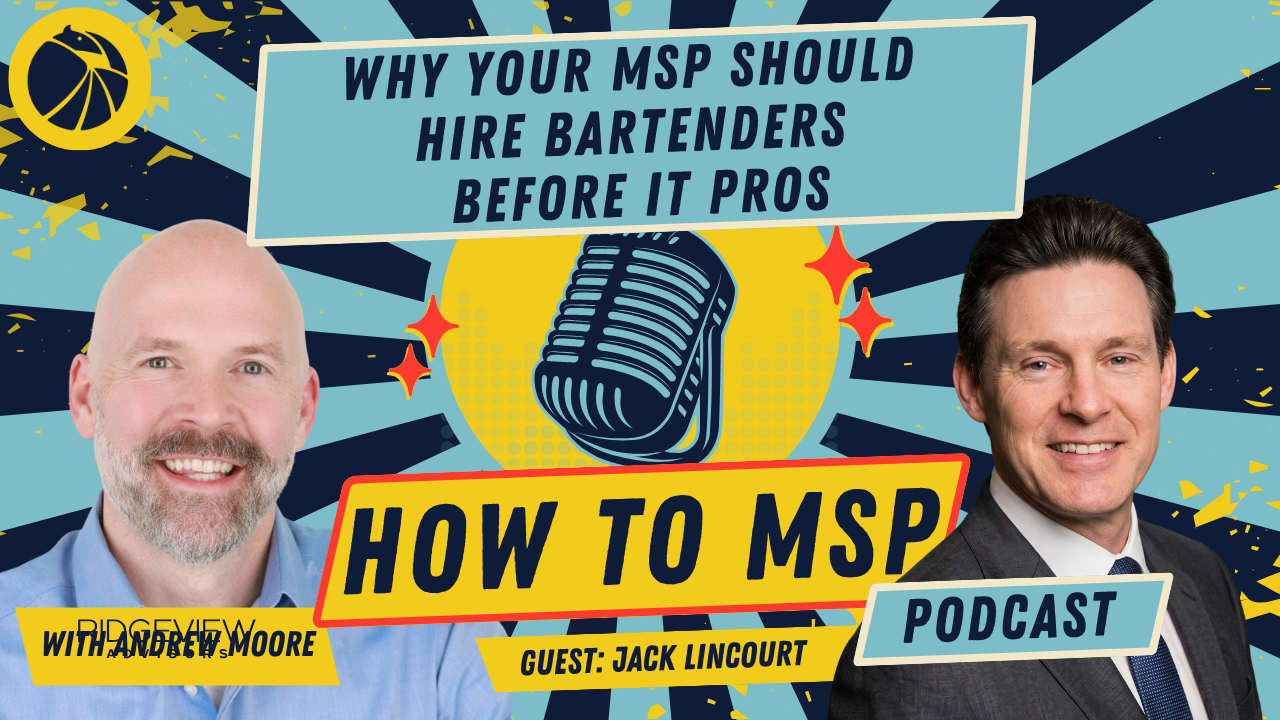
Why Your MSP Should Hire Bartenders Before IT Pros
Jack Lincourt of Microtime gets brand-new hires with zero IT experience handling 85% of MSP tickets in 90 days by hiring for chaos tolerance, not certs.
Watch
Listen
Subscribe on How to MSP© Podcast.
Would you put a Dunkin’ Donuts drive-through worker on your help desk before a Geek Squad tech? Jack Lincourt would, and his numbers say he is right.
In this episode of the How to MSP© Podcast, host Andrew Moore sits down with Jack Lincourt, VP of Service Delivery at Microtime Computers and a 30-year process-and-people leader, on how he built one of the most disciplined help desks in the channel by hiring for chaos tolerance instead of certifications.
What this episode is about
Jack’s contrarian claim: you can teach IT, but you cannot teach customer-service instinct or the ability to stay calm when the phone will not stop ringing. So he hires for the traits he cannot install and trains the skills he can. New Microtime techs arrive with little or no IT background, some straight from a drive-through window, and inside three to four months they are independently closing the 85% of tickets that fall into known categories, on-call rotation included.
“For our company, we care more about their customer service skills and about their teamwork mentality than any technical skill.”
- Jack Lincourt, 4:41
The engine underneath that result is process. Jack once read 5,000 historical tickets by hand to find what actually repeats, mapped them into ConnectWise type/subtype/item categories, and wrote a step-by-step template for each one. New hires run the templates first, which both makes them productive fast and surfaces any template that is wrong before it bites a senior tech in a real outage.
Questions answered in this episode
- Why “I can teach IT, I can’t teach customer service” is the right way to hire a help desk.
- How a brand-new hire reaches 85% ticket coverage in three to four months.
- How to build a template library by reading your own ticket history instead of buying a tool.
- How a below-market base plus stacking certification bonuses turns a $38K hire into a $70K tech in three years.
- Why a process-first MSP adds tools slowly and refuses to bolt AI onto broken process.
Why it matters for your MSP
Jack’s playbook maps directly onto the operating discipline we teach. The redundant, documented 12-page onboarding checklist is exactly the muscle behind what belongs in an MSP onboarding checklist. His “read the tickets, build the templates” method is the same process-and-people work in tapping the armadillo, and his deliberate, owner-first approach to tooling is the antidote to MSP tool sprawl. His advice for a newly promoted leader, fix one thing, get the win, then the next, is the heart of when to hire your first service manager, and his certification ladder is one way to turn techs into trusted advisors who stay. That capability-building is where the financial payoff sits: Service Leadership’s 2025 profitability research (opens in a new tab) (ConnectWise, 2024 data) found that the highest operational-maturity providers run roughly three times the EBITDA margin of their median peers, and operational maturity is built one trained technician and one documented process at a time.
About the guest
Jack Lincourt is the Vice President of Service Delivery at Microtime Computers, an Andover, Massachusetts MSP serving northern Massachusetts and New Hampshire. He brings more than 30 years of experience leading client services, technical support, and operations teams, with a focus on building high-performing, customer-first help desks through deliberate hiring, documented process, and the right tools. Known for his “Go Hard or Go Home” mindset and lead-by-example style, Jack is also a working musician who plays in the cover band Gain to Eleven, the power-metal band Shadowlynx, and several Iron Maiden tribute projects.
Resources mentioned
- Guest: Jack Lincourt, LinkedIn (opens in a new tab) · Microtime Computers (opens in a new tab)
- Book: The Ideal Team Player by Patrick Lencioni (opens in a new tab)
- Tools mentioned: ConnectWise (opens in a new tab) · IT Glue (opens in a new tab) · Rewst (opens in a new tab) · Cyft (opens in a new tab) · ThreatLocker (opens in a new tab) · Criteria Corp / HireSelect (opens in a new tab)
- Music: Journey (opens in a new tab) · Iron Maiden (opens in a new tab)
Ready to build a help desk that runs on process instead of heroics? Subscribe to the How to MSP© channel for more deep dives into the business of managed services.
Transcript
The full transcript is on the page (crawlable for search), collapsed for readability.
Read the full transcript
Jack Lincourt (00:06): And if I have to call a customer to say someone was following an established process and it caused a problem at your practice or at your business, I have no problem making that phone call because we've already got a good relationship with them. They know we run on process. They know we work with people that are following steps to do it the right way. So if something bad happens, they know we're going to fix that process so it doesn't happen again. Having that credibility with our customers is key to growing people because it means that the customer doesn't get mad at the tech for making a mistake.
Andrew Moore (00:38): All right, and welcome to today's episode of How to MSP. I am your host, Andrew Moore, and today I have a very special guest. He is someone that I admire very much and I've known for, ⁓ I think over 10 years now or longer. This is Jack Lincourt of Microtime Computers out of the Boston area. He is the VP of Service Delivery and a complete and total badass when it comes to processes and management and service delivery and I am absolutely honored that he is on the show today and we have the distinct honor of being the first podcast that Jack has ever been on. So that's actually super cool. So Jack, ⁓ welcome to the pod.
Jack Lincourt (01:21): Hey, thanks a lot, Andrew. Really happy to be here. This is really exciting for me.
Andrew Moore (01:26): Awesome. let's just start with real quick, tell me where are you at today? Where are you physically? Where does the podcast find you?
Jack Lincourt (01:36): Well, I'm just north of Boston. I'm actually in my home office right now. Came home just for you, because everyone that knows me knows I never leave the office. But you know what? For this, you got me at home. That way we have all the time in the world. No interrupt.
Andrew Moore (01:47): Wow, what an, well, no interruptions. I'm sure you'll probably get bored of the conversation and go like start playing guitar or one of the other like thousands of things that you do because you don't sleep. So I love that. But thank you. It's an honor that you took time away from the office for us. ⁓ Let's start with, know, why should people listen to you? Like what have you been up to? Like where did, how did you get to where you are? ⁓ Kind of give people a little background on your journey and what you do for micro time.
Jack Lincourt (02:18): Well, currently I'm the VP of Service Delivery at Microtime, as you stated. Basically, I run the service delivery side, whether it be the help desk, ⁓ I oversee our security team. ⁓ We do have a project manager, so I don't oversee projects, but I do help, because we know in service we help with everything. The way I got here is I've been doing process and people management for over 30 years now. And it's what I have a passion in. And over time, getting into IT 15 years ago became people, process, and tools. We didn't have tools back in the day. It was people and process. And I've been able to find the right people, manage to the right process to just help businesses succeed. And that's what really encourages me to move forward and hopefully encourages my teams to do well and succeed is teamwork. And ⁓ having a process to follow that can build your business and can make everyone happy and you don't have too many cowboys, et cetera. And if you can find the right people, that process starts with finding the right people. That's process too.
Andrew Moore (03:29): Yeah, let's start digging into some of that. And just for the sake of people who may not stick around to the end of the podcast, I will just inform you that Jack is a hell of a musician and is the lead singer and plays guitar in a... Heavy Metal or Death Metal or whatever it is that you're doing, but then you also play in a really kick-ass cover band. So he's got a man of many talents. I'm excited about the conversation at the end of the podcast where we're going to dig into music a little bit with Jack. So stick around for that. ⁓ Let's start with processes and let's talk about people, processes and tools. You had ⁓ mentioned that it starts with people. I do want to get into process, I misspoke there for a second. I want to start with people. How do you find the right people managing your service delivery team? What have you been doing over the last five years or so since ⁓ COVID to make sure that you're finding the right people in this post-COVID environment, whether that's here or remotely? What does that look like for you? How do you manage that team? Where do you find those people?
Jack Lincourt (04:41): I've actually been following the same process for like 13, 14 years now. We put out an assessment that's sent out by Criteria Corp, Hire Selectives, some people know it. And we've just got a battery of tests. It kind of just gives them some basic English and math, make sure that they speak the language and they can communicate. It's got some typing on there. But the most important thing to us is the personality profile. For our company, we care more about their customer service skills and about their teamwork mentality than any technical skill. or any other competency that they have. know, when I do an interview with somebody, I'm just having a conversation with them. I talk almost nothing about IT. I want to know about the person that we're potentially bringing into the company because I want to make sure that whoever we bring in not only has the people process tools, you know, ideal teammate, you know, or ideal team player mentality, but I can sit them next to anybody else in the business, no matter what department they're in. and they can work side by side for a day, a week, a year, you know, et cetera. And if I can find someone that fits the culture, that already wants to work in our business, wants to work in IT, wants to work in technology, well, we can teach them anything that we need to teach them, but you can't teach them how to be a good person. You can't teach them how to be a good teammate. That can come over time, but you know, we don't have time like, you know, a one, a coach to teach someone how to learn teamwork. We're working with adults here. So I want to work with somebody that's already got a teamwork mentality, a team first mentality, and a customer service mentality. So everyone we hire, no matter what position we're looking for, has to have a customer service background, and they have to have really good competencies when it comes to working with people. So the battery of tests that we send out will give us core competencies on just how good do they function as a human being, shall we say. But if they get past the basic averages there, We look at the personality piece and we're looking for someone that's more of an extrovert than an introvert, but not too far. We don't want someone that you can't stop talking. You got to find somebody that can actually be productive. We're looking for someone that has a good sense of agreeableness. I want someone that thinks for themselves and will stand up for themselves when they believe that they found a good process. But I don't want somebody that's so hard headed that they're not willing to try something that somebody else suggested. And then of course, we're looking for some of the good stress tolerance. You know, in the MSP world, everything is, know, everything at once, and there's always a lot going on, and everything's an emergency. So I need someone that can handle that with a good sense of calmness without being so calm that they have no sense of urgency, or at least they don't convey a good sense of urgency. You know, we've got plenty of people that can take it calm, but we have to still have the confidence to explain to the partner they're working with or the teammate they're working with that, we got this, but this is important. And you can find that in these batteries of tests, just in the personality profiles and with the other types of pieces that we do in the test. If somebody gets through those battery of tests, which does take like an hour, hour and half to go through that test, which some people don't want to go through. So test number one is, hey, did you get past the test? Right. And if we get through that and I say, hey, this looks like a good person to talk to, I do look at the resume and I want to make sure they have some form of chaos management? Did they work at, you know, drive through at Dunkin Donuts? You know, did they work, you know, were they a bagger over at Stop and Shop? You know, or did they actually have MSP experience or some sort of office job experience where a lot was coming at them? And did they last at least six months in those roles? Someone that can deal with people and deal with chaos management, consider my help desk. You know, and that's what's important. If they have that type of competency to be able to handle chaos, while also being a teamwork, first mentality and be a good person to be around, I can teach you anything you need to learn when it comes to technology and helping people and using our tools. And so that's where it all starts.
Andrew Moore (08:45): So question, I'm gonna jump in real quick. My question to you on that is, are you hiring anyone that is already experienced to be a part of your service delivery team, or are you mostly focused on trying to raise people up? Are you looking at, you had said, this is the kind of experience I want you to have, like working at Dunkin' or being a bartender or places where there's service plus, action are you saying those are the kind of people that you want and you're not going to take an IT person maybe out of an existing internal service desk team or maybe from another MSP like what does that look like for you on top of like who you're trying to bring in but at what level do you bring them in in order to to get them to the to the place that makes them successful with micro time
Jack Lincourt (09:35): That's a great question. And I get that question often. We actually hire people with minimal to no experience. You know, we're looking for people that have that edge. They want to get in technology, but no one's given them the chance. Someone that maybe worked at like their school's IT department in college or in high school. Someone that maybe worked for Geek Squad for a short time, but can't find the real job, shall we say. Not to say Geek Squad's not a real job, but they're looking for that real stepping stone in IT. and someone that's invested in themselves. Maybe they went to college and graduated. Maybe they're in college. Maybe they got some certification courses or some certification, actual certs under that belt. We've got people that have come in that are fresh out of high school, and then we have other people that are changing careers in their 40s. And they've just really had a passion for technology, and no one's really given them the shot. And the way we find them is because we use a recruiter. And the recruiter basically just sends out our exam to lots of people. I our assessment. I get a lot of assessments every week. Even if we're not looking, I say, keep sending them year round. I'm looking for that diamond in the rough all the time. Anyone that meets the right profile, I want to talk to. And if they're a good fit for us, can we find a place for them until the right role is ready for that? So I'm not looking for that person with lots of experience. People that come in from another MSP, that would be great. But they also come in with habits. They come in with expectations. And I want to be able to kind of mold somebody. the team likes to mold people. Everyone on my help desk came in the same way. They all came in as a level one tech with almost no experience, if any at all. ⁓ Maybe a cert, maybe a degree, maybe nothing, but the right aptitude and the right attitude. Because of that, when somebody comes in behind them, they're willing to train them. They're willing to mentor them. And the person I bring in needs to have the right mentality that if I hire somebody else in two or three months, they're going to help mentor that person to learn the stuff they just learned. And everyone just keeps growing and keeps learning. And we just become a well-rounded team of people that have lots of skills. Everyone's going to want to go in their own direction on how they want to learn. Some people want to have a full pyramid of everything related to IT. Some people want to concentrate on networking, some want to concentrate on just server work, stuff like that. You some want to go on the cloud. But everyone has the core competencies. And what I want my help desk is to have a bunch of people or you know, the right amount of people for our company to have the right core skills and then have interests elsewhere. Even if that interest is outside of IT or outside of our help desk, they still want to keep learning. We're looking for hungry people. said earlier, humble, hungry and smart. I need people to be hungry and stay hungry. And so how do I feed that hunger? We put them in an MSP. You learn every day. We got people that have been with us 10, 15, 20 years and they learn something new every day because the industry changes, tech changes. IT is scary and it's exciting. And I want people to feel that excitement every day. I want them to go home knowing that they learned something and that they helped people. And I want them to be excited about at least one of those things. And so when we bring in people, we let them know upfront, you're starting in the same place that everybody else did. And because of that, you're going to be working with people that want to help you. Not just because they like helping people and they're excited to have a new team member, but it also means that if you're working with somebody else, you might be taking something from them. that allows them to now do bigger and better things themselves.
Andrew Moore (13:27): So let's talk about bigger and better things and what happens on your service desk. Do you keep most of the people that you hire on the service desk or do they move into other departments? Do they see this as a career stepping stone and they move on to another organization? How do you see the line of succession within the business and how do you feed other parts of the business the talent that you develop there within the service delivery team?
Jack Lincourt (13:55): Perfect question. So we have many departments in the company that people can move on to if they choose to do so. When we bring in new hires, we do ask them what they aspire to do. Things always change over time. Obviously, we've got a lot of people when they first walk in the door, they're talking about, oh, I'm going to get three certs in the first month. Plus, I'm to get some college courses while I'm working. And I'm like, slow down. I know you mean that. And I've heard that before. I know that you have every desire and every ambition to do that. But you're going to get so much learning throughout the day. that by the end of the day, you may or may not be having any energy or having enough energy to go do some training. So over time, people's interests change. ⁓ I typically have very little turnover, if any turnover. We don't really lose people very often. And if we do, it's normally because they moved out of the area ⁓ or they went to go run an IT team someplace else. So I'm very proud of that. I'm very proud that, know, typically people either stay on my help desk because they enjoy the team they're on. They enjoy the customers that they're working with, and they simply like helping people. But we do have people that go beyond level one, level two, level three, which we don't really talk about much on our team. We're all just help desk. We're here to help people. We can call everyone in our business to just say, we're all customer service. That's what we do. But some people like to have titles. I can call you a level three tech or a level three engineer. Whatever you want to be called is fine. But if you aspire to go beyond our project team, and you want to implement things. You want to actually get out in the road more than you do on the help desk, because our help desk people do dispatch. But if you want to get out in the road more and actually implement infrastructure, ⁓ by all means, there's an avenue there. Positions do open up there as we grow. We do have a central services team who handle security and proactive services. So we've had people leave the help desk and go actually build our security team. You know, the person that's essentially running our security team right now was a member of our help desk for two and a half years and had a great proclimacy for security. They really love security and they were doing all kinds of research and we're like, you know what, you'd be perfect for that team. And within a year they were running that team. You know, mean, that's terrific. And that's what we're looking for, people that stay driven. And if we find a spot that's going to suit you best and it's going to be what's best for the company also, let's put you in there. You know, and for the most part, have not really failed in a sense of putting somebody in a new department that they want to be in and having them not succeed because they know they have that avenue. And then what it tells everybody else in the help desk is that if you decide you want to work for another department, there is that opportunity. It may not be there all the time because you're not always hiring for certain positions, but as we grow and as they help us grow, you know, then those positions become available. One thing that I have been very pleased with with the help desk that we've grown here at Microtime is we have a group of people that actually get excited when we have a new customer. I've never worked in an organization that the help desk is excited to hear we have a new customer. It's always like, ⁓ more work. Selling more stuff, right? more people I got to learn. got to...
Andrew Moore (17:05): Dude right people are- yeah ⁓ shit there they go again selling more stuff right like those those fucking guys
Jack Lincourt (17:13): I gotta help more people, more calls, I can't believe this. Instead, they're interested in, what new business are we doing? What new stuff can we learn about? And in the back of their head, they're also thinking, as we grow, more people we can bring in over time. Now we have good processes, so you gotta grow a significant amount before you bring a person in. But. As we grow, you're going to need more people on the project team. You're going to need more people on your security team. You need more people over in, you know, client account management. You know, so if somebody aspires to be in another position, they know the only way for that to happen is for us to keep growing. And how do we grow? We grow by maintaining the customers we have. How do we maintain the customers we have? Great customer experiences. Great customer experiences start with great customer service with great people, with great process. with great team players, know, great documentation, you know?
Andrew Moore (18:04): So let's, yeah, I love your shirt. Yeah, I think that's amazing. And I'm gonna dig into that in just a second. We start getting into processes, but I wanna touch on something because I hear you and I'm gonna play the devil's advocate here and say, Jack, that's amazing. I love what you're saying. Let's hire the right people. Let's give them opportunities. ⁓ Let's make sure that we're providing them the chance to learn and grow. But what does that? actually mean? Like what do I do as a service manager to make sure that my right off the street bartender who likes to work on computers on the weekend is actually going to be impactful and managing tickets on my team within 30 days, right? 60 days. Like what does that look like? How do you get them where they need to be? Is it six months, 12 months? What do you see there as far as your process for getting somebody from entry level to team impact high user experience.
Jack Lincourt (19:08): Well, the way we do have a training program, know, not like in a training room or something like that. We have a whole guide that says these are the items we want you to learn over your first three to four months. You know, it's pretty much a three to four month, you know, program. And it's not based on how fast you learn because most people learn around the same rate, you know, close enough. It's really how fast we can train you depending on how busy we are in the other areas. You know, as we all know, you bring in a new hire or several new hires. It's it's a load on the team. Now they slow down because they have to show you things, they have to help you. And so depending on how fast we can train you, within three to four months, which is everyone in our organization is always within three to four months, gotten to what we'll call the 85 % plateau. 85 % of the tickets that come in should be able to be handled by anyone that I've had on my team for three to four months. And that also means I can put them on our on-call rotation. because that means I can trust them to take care of tickets after hours and they know their escalation points for things that they can't handle. But what's important is that as the team grows, it also expands our on-calls ⁓ group. So the team gets to be excited that it's an extra week longer before they're on call again. ⁓ But the whole goal, and that's kind of what our team aims for, is that definitely by the end of four months, this person is going to be on the schedule to be on their first on-call. And the team takes responsibility, not just the service manager, not just the service coordinator, not just the VP of service delivery, but the team, level one people, two people, three people, everyone on that team takes responsibility to getting that person to the level they need to be so they can be in that on-call rotation. And it doesn't mean it's just all about on-call. It's really all about if you can be on call, I can trust you with answering the phone. I can trust you with handling your own tickets. I can finally not worry about you picking up the phone and trying to help right away on something you have no business trying because you now understand what you should be touching and what you shouldn't be. One of the biggest challenges we have in the beginning is, we put people on the phone within the first couple of weeks. All we want to make sure is that they know how to use our ticketing system, ConnectWise. We want to make sure they know how to use, you know, our remote tools and all that. But if you can use ConnectWise and create a ticket and you know how to answer a phone and you can be friendly, you can answer a phone and create a ticket. Even if you think you can fix the problem, we have to be very stern. Don't try and fix anything. I don't want them dragging you into something that sounded like a password reset but turned into a whole Sage update or something like that. And so if we can get people to start there and have some discipline.
Andrew Moore (21:51): Yeah.
Jack Lincourt (21:56): then over time we'll start trusting them to start making the decision on, yes, I can take them. So we'll start taking calls and saying, hey, this is just such and such, can I take this one? In the beginning, we say, nope, let it go, create the ticket, and then we might have them call right back. And that way, hey, the customer gets used to talking to them. ⁓ But over those three months, they get more and more comfortable. They get more and more confident. We build more and more confidence in them, and the team builds more confidence in them. And then, of course, that means they build more confidence in themselves. The confidence anyone can walk in and play the part of a confident person. But when you're actually confident in yourself and you can actually do a good job and you know you're going to do a good job, even if what they just threw at you is baffling, you've never heard of any such thing, but you can be like, wow, that's interesting, as opposed to, my God, I've never heard that before. You can't do that in the first week or two. So if you try and help people too early, you get stuck there.
Andrew Moore (22:42): Right.
Jack Lincourt (22:54): It might be surprising to hear that within three to four months, any IT issue that comes in our door, know, 85 % of the IT issues that come through that phone or come into the ticketing system can be handled by someone that's never touched IT prior. It just goes to show the dedication the team puts in to training people to be prepared to handle it and also the ability of the person to know when to escalate things. And when we escalate in our company, we don't give it to somebody else. We stay on the ticket and that person teaches them how to do it unless it's something that is far beyond scope. We're not gonna have somebody programming a switch or something like that on a phone call. That just feels silly. But if somebody has a VPN type problem and someone is familiar with it but hasn't done it before, our goal is to make sure by the time that ticket's done, they know how to do this and they can do it again next time.
Andrew Moore (23:35): Right. So when you are looking at that first three to four months, I'm fairly certain that you have either a spreadsheet or a project template in ConnectWise or something that you're sitting down with the individual and saying, here's all the things that we're going to expect you to do and when you're going to do it. Is that something that you have? a learning management solution that accompanies it? Is it knowledge based articles? Is it video content? How do you make sure that you are optimizing their time as they begin training and making sure that you're creating consistency in the training deliverables in order to get them to the point where they're following the processes that you put in place? What does that look like when you're trying to bring that person on board?
Jack Lincourt (24:36): Plus it's all about templates. It's all about documentation. It's all about having a process. So onboarding a new employee is just like onboarding a new client. You have to have a checklist and you have to go over that checklist and you have to follow up on that checklist regularly. So in the training guide that we have, obviously it's a project template and ConnectWise and there's a lot of redundancy. So if you are working on subject A, week two, you're probably also looking at it week three, week five, et cetera, with different people. to make sure you've got this down. So week two, you're just getting familiarity with it. You're talking to a person that they're working on a ticket. Week three, it might be, hey, give this a try, I'll walk you through it. By week five, hopefully it's just a checklist that you say, yep, I've done that, and you've shown somebody how to do it. Now, you might go in week two and take care of all three of those steps, because you've had enough opportunity. You might be in week 15, and finally get to step two, because this just hasn't been an opportunity to learn that item. And some items you really need to have a ticket. You need to have a real life scenario to learn that item. So the objective for us is to make sure that we have a checklist of things we need you to learn and make sure that we have tickets assigned to you and to other team members to make sure that you learn them. Sometimes the ticket is really, it's not even a training ticket. Sometimes it's the service coordinator knowing that next time XYZ type ticket comes in.
Andrew Moore (25:36): Mm-hmm.
Jack Lincourt (26:02): I need to add our new hire to that ticket along with someone to show them how to do it. And then we check it off the list. And that way by the end of the period of time, we can say they've done this, this, this, this, this. OK, we didn't touch this, but that's very rare. So it's OK. We can show that to them when that opportunity arises. And the reason I say the three to four months is because sometimes If you're really bobbed or if you're really short staffed, it's hard to take the time to show people. So sometimes it takes longer to train the busier you are. And so it might take four months, it might take a little bit more, but typically within the four months you get through that whole checklist. It's like a 12 page thing if you print it out. And it doesn't say how to do anything. It literally says here's what we need and here's some bullets under it of the subject matter that we want you to learn while learning X. You know, an easy example would be if you're learning ConnectWise, that's obviously first week, you day one you learn ConnectWise, you know, university. But if you're learning ConnectWise, you need to learn how to create a ticket. You need to have, you know, what are configurations, you know, all the little things that go into it. How do you bundle a ticket together? you know, things that become second nature when you're using it, but I need to get you that familiarity right up front. And then we go over again a few days later. What do you remember? Because you need to start creating tickets now. and I need you to be able to find a customer. I need you to be able to find the end user. I need you to be able to add the configuration with the proper person's machine if you can find it there, know, things like that. And so the redundancy of going over it over and over again, make sure that it starts to, you know, really, you know, be learned. actually it's being absorbed and there's a lot to learn because you're learning systems, you're learning tools, you're learning processes, and you're learning how to do IT. You're learning about new customers. You're learning how to talk to people. There's so much for someone to learn, which is why we need people that are so driven, that they're excited to be here. Earlier on, we were talking about people and how do we find the right people and how do we make sure that they grow by using a hiring agency instead of having people just apply directly to us. And I'm going to say this in the most respectful way possible, by using an agency of finding people that are struggling to find a job. Okay, you if they had no problem finding a job, they wouldn't need the agency. If they had people knocking on the door, they wouldn't be using an agency. So by knowing that we're using an agency to help us find people, we know that by giving them an opportunity, we're giving them an opportunity that others are not giving them. We're also giving them the opportunity to learn on a team that most companies don't have the luxury to do, ⁓ or the time or the patience. They want people that can sit down and be productive. They're paying them to be productive. They're not paying them to learn. Well, we are paying you to learn because we're paying you to be a good team member, not just to be a ticket monster. know, so we also get a lot of people that are just grateful that we gave them that opportunity. And so we get longevity with them. They might get other offers because now they've learned a lot. They spent a year or two at an MSP. They've gotten some certifications in the meantime, which of course, one of the main things that brings people in for us is that we have a certification program. You know, every cert you get, you get a raise and we're paying for your training. We're paying for the whole bit and you're getting a raise when you get the cert. So it allows you to invest in yourselves while we invest in you and you get to grow. And a lot of companies just don't have that either in the budget or they don't have it. Just, not what they do. You need to sit down and produce and your expectation. is that you keep up with best practices. we have that expectation, but we also are going to help you get there. And by bringing in people that way, ⁓ we gain their respect and the love of the people that come in. And I can't think of the right term right now, but for the most part, we end up with good people that appreciate who they work for and who they work with. And so they end up being that same person to the next one that comes behind.
Andrew Moore (30:15): ⁓ Yeah, let me double click on something real quick that you were just talking about. ⁓ You were in, we were having a conversation and you had talked to me once briefly, and I don't know if you're still doing this, about how when you were using the recruiting firm, they would bring you a candidate, you would make an offer to that candidate, and I believe that the candidate would start at a certain, either hourly or base salary with the expectation that they would achieve a certain level of proficiency over 90 days, six months, whatever that was. And at that point, we'll call it a more advanced position or permanent position was then presented to them as a reward for finishing that part of what they were doing. And then they were put into a track where you would say, you get this certification, we will give you additional monies or bonuses. Right? So you were putting people in positions to achieve things for the business, but at the same time they were constantly being put in positions to receive additional compensation for their effort. Are you still doing that? And if you are, can you explain it? Or if you're not, can you explain what you are doing when it comes to that? Because you did say bonus on or raise on certification. So I'm not sure that all MSPs are doing that or have found success with that. So can you talk about that a little bit?
Jack Lincourt (31:25): Yes. Yeah, absolutely. So we have a base salary. Everyone starts at the base salary and then we add to that. And the base salary we have is probably a good eight to $10,000 less than what they would make someplace else start it. But you add that any search they have for their education. So if you have a college degree, you know, if you have a bachelor's in any kind of technical field, you know, we're going to add $4,000 onto your starting rate automatically. And $4,000 obviously, per hour since I got $1.96 an hour, know, something like that. And then each cert you have adds to that also. So any of CompTIA certs, we currently pay $3,000 for any of the CompTIA certs. So you get an A +, and an N +, and a Security +, you just got $9,000, you know, just added to your base salary, you know, on top of your college degree. If you have one, if you have nothing, you're starting at the base salary, but we're gonna put you on track to get these certifications. Now we have other certifications that are a bit lower. You got Google search, you got Apple search, got phone search, know, Meraki search, you got all kinds of certifications you can get. And it's all listed out. We have a whole certification metrics that lists out all the search we have, what the expectations of them are, how to get them, and how much of an increase you're going to get for each one of those. The Microsoft, you know, certification path, you know, starts off with prereqs. Then it gets into a little bit harder, a little bit harder as anyone that's gone for like the Azure certs and stuff. You know, each level gets really more in depth and some of those certs you're getting, you know, $7,000, $10,000 increase for getting some of those certs. They're hard. It might take you a year to get that cert, you know, but there's a great reward at the end. Not only are you getting your financial reward, but now you have enough knowledge that you're helping the team and you're the go-to person. People like being the go-to person. We're looking for that person that's driven, right? Humble, hungry, smart, right? We want people that are proud that people come to them for this. We don't want people that constantly have to ask for help. know, so people that go and get certified have that sense of, hey, now I have this knowledge and I can share that with others that either couldn't get that cert, haven't had the time for it, or are on that track also. But to go back to where we started, you have your base salary, then you add onto it each piece. Now, if you have three level one certifications. We'll call level one like an A plus, N plus, et cetera, or some of the other ones we talked about. And you add on a level two certification. Level two certification will be one of those higher Microsoft certifications, maybe a CCNA, areas like that. People would get the MCSA of old, which is now like some of these Microsoft ones that people get. I'm dating myself right.
Andrew Moore (34:24): You're dating yourself.
Jack Lincourt (34:28): When you go and get one of those level two search and at least three level one search and you now have the official title, as long as you are mentoring the team and you're still, to be honest with you, you're still part of our team, we consider you a mentor and a trainer and part of our team. We used to say, and you have to also be a certain type of person to be considered a level two technician, right? So you get your three level ones and your one level two and you level up, you become a level two. tech, know, level two tech engineer, whatever you want to call yourself, because we're not big on titles. And we'll give you another $4,000 on top of what you've just made for that last cert. And we'll call you a level two. When it comes to level three, you have two level twos, two level two certs, one level three cert. Level three cert, you know, some of those, you know, higher end, get CCMP now, right? Things like that are one of those $10,000 certs you're getting to become an Azure expert enterprise And you get a $6,000 raise there on top of whatever cert you just got. So you may get a cert for $10,000 and end up with a $16,000 raise. So yes, we are starting lower than most companies, but we're giving people the opportunity if they want to invest in themselves to sky's the limit, up to $10,000 a year in cert pieces. Now the extra things for like the level ups, are, you know, that's extra. But for cert increases, we give up to $10,000 a year in certs. So if somebody starts at a lower rate, like a $38,000 or something like that, they're with us for three years, they can be making almost $70,000 or more by just getting certs. And on top of that, we do have increases at the end of the year when we raise rates to our customers for cost of living. We do provide that increase that we charge our customers gets spread out to our employees. So that way they also have a chance each year if they couldn't get any certs, but they're still killing it out there, I wanna be able to reward people for a good job. we don't only provide increases for certifications, because we understand some people have families, second jobs, other responsibilities, or are just poor test takers and aren't able to get certs. But if they're still a great employee doing a great job, I don't want to penalize them. So I want to make sure we do have ways of rewarding people outside of just a cert program.
Andrew Moore (36:42): That's fantastic to hear and it gives some framework to what you guys do. So I appreciate you sharing that. I hear a lot in the way that you talk about things that it's a given that you have a process for something. Right. So I don't want to ignore the fact that specifically with you, I think you are most impressive skill is your ability to take a complicated system and break it into logical pieces. I was going to pause there for a second. If not, if not large logical pieces, you get very granular with your processes. get very atomic with the ability to look at a process and break it down to its most fundamental components. Can you talk to me about how you're doing that with your service delivery team and what you do when it comes to how they're working tickets, what your expectations are of them and how you're building their processes. What do you do to make sure that everybody is working at the same level that you are? Because you are very detail oriented when it comes to stuff like that.
Jack Lincourt (37:54): I'm going to say it comes from being willing to do brute force meticulous research. In the beginning, when I first started my journey managing IT teams with no IT background, what I did was I had looked at five years worth of tickets from the company that I was working for. And I took a look and saw what did people do? What did people document? How did things connect? you know, what was considered a network issue, what was considered a server issue, what was considered an ⁓ ISP type issue. And then I would put, I put them all into categories and I figured, okay, well, tech A can do this in 20 minutes, but tech B, C and D typically take about an hour. So is tech A taking shortcuts and not really fixing the problem? Or these other three techs need some training and I can use tech A to show them. So what I did was I, kind of looked at all those different pieces to say, how long should it really take to handle this type of problem? And can we, number one, can we automate it? You know, that's always first, right? Can we automate it? You know, but if we can't automate it, you have to actually do some work. What's the best process to get it done quickly where it's also solving the root problem? One of the things I also did was make sure that if tech aid took care of it in 10, 20 minutes, that we didn't have that same ticket coming up for that same customer within the next couple of weeks or months. You know, obviously it took months to do this, know, five years worth of tickets. but what I was able to do is I was able to build within ConnectWise a type, subtype, and item categorization that showed how things are related and then build templates. When ConnectWise, you can build a template based on the item of the type, subtype, and item. So if somebody has something like a slow workstation, and I can see that tech A handles these slow workstations within 35 minutes. every time, it's always done in 15 to 35 minutes, what steps do they take? Do they have a process? And if they don't have it written down, can I get them to write it down? Can I work with them on that? Document that. Put that into a template. And then every time we have a slow workstation ticket, I can have that template just automatically populate into the ticket with instructions and give that ticket to anyone on the team that's been here for three months, three weeks, whatever the time being is. depending on what expertise is needed to get down that list. And so I've had people that haven't worked much in IT work on things like slow workstation or low disk space, ⁓ your printer issues, which we know there's 500 things you can try with a printer, you know? But if you have a checklist to go through, it shortens the time. You don't have to try and reinvent the wheel all the time. You don't have to jump on YouTube or Google to find the information. or try and look through 400 tickets to see who worked on this last. Now, of course, we want people to look into the documentation system by TGOO. We want them to look in the ticketing system to see if anyone's had a previous ticket of the same item. But it's a lot easier if my service coordinator triages a ticket and boom, there's instructions right there. By doing this, it also allows our newer techs to try these processes and see if they work. Because if they get to step three and they broke something, I expect them to say, hey, I tried to do this and it rebooted this server. my goodness. Right. You know, so we got to change this template. Right. So instead of going through 150 templates every six months to make sure they work, I give them to my new techs. People might say, my God, that's scary. You're giving a new person, you know, the ability to break things. Hey, I want them to spread their wings. I want them to trust the process. I want them to know that they can make a mistake and we have their back. And if I have to call a customer to say someone was following an established process and it caused a problem at your practice or at your business, I have no problem making that phone call because we've already got a good relationship with them. They know we run on process. They know we work with people that are following steps to do it the right way. So if something bad happens, they know we're going to fix that process so it doesn't happen again. Having that credibility with our customers is key to growing people because it means that the customer doesn't get mad at the tech for making a mistake. Instead, they're dealing with the issue that happened, they'll work with management to make sure it doesn't happen again. And then they're still perfectly happy working with a technician that was following process. With good.
Andrew Moore (42:24): No, that's that I love how you put that about how if you've got a process for how you're handling an issue typically and you're following that process and it results in a negative outcome, that's a much easier conversation to have with a client because it really is. It's way better than like, yeah, that guy was cowboying or or you know, not we don't have a process for that. Like it doesn't instill trust in.
Jack Lincourt (42:41): It is.
Andrew Moore (42:50): clients when you're like, nah, you know, we just kind of say we sent it to this guy because we thought he was smart. He figure he's going to figure it out. ⁓
Jack Lincourt (42:52): precise. Right, right. Yeah. And you're so that's, that's one piece of it. You know, other you know, when I say brute force is because I try a lot of things. When we come up with what type of metrics do we care about? What is actually important? Everyone's always looking at ticket counts and how many tickets do we close? What's your kill rate and things like that? You know, I'm looking for repeat problems. You know, I'm looking for surveys, I'm looking for first touch resolution. And first touch resolution, that ends with no repeat call. First touch resolution means nothing to me if they're to call back tomorrow with the same issue. And that's why I say customer service is key, is because I want people to, embedded in them is to find a way to prevent this from happening again, to keep the customer from being frustrated and not being able to work, but also keeping our team from having to fix the same thing every single day. The less tickets on that board, the more time they have to learn
Andrew Moore (43:33): Right. Right.
Jack Lincourt (43:55): to take their time on other tickets or to be honest with you, enjoy the team. We have a good team that gets along with each other. I love hearing them talk about video games and movies and sports. I love hearing those conversations because it doesn't mean that we're slow. It doesn't mean we have nothing to do. It means that they actually have a minute to breathe and they're not overwhelmed and just constantly only 400 tickets on their board at all times. They're all very busy. It's still an MSP. There's never a moment where someone has less than 10, 20, 30 tickets on their board. But I still want people to know that what they do matters. And if they can, you know, put the time in to find a root cause, fix it, share that with the team, and that way everyone can do it faster, it means they can concentrate on other things that help them learn and feel smarter. People want to feel smart, right? And, you know, especially in IT and technology, you get driven people They want to feel important. And customers make them feel important every day with all the thank yous and, you did so great and thank you so much for following up. That makes you feel good. But how often you get to walk away saying that your process you built or that information you found out really helped us as a team. A lot of times the satisfaction you get from your team members is way more rewarding than the satisfaction you get from any customer that says thank you. And that's building the process.
Andrew Moore (45:17): Dude, dude, that's 100%. That's 100%. I was listening to a podcast recently where the gentleman had talked about positive reinforcement in systems, just in general. And the most important creation point for a habit is positive reinforcement. And that positive reinforcement often is more impactful when it comes from a team member. Right? Or you're in a team environment and someone is calling out a positive behavior. Right? And so they use it in the military all the time. As much as you see them getting yelled at for doing goofy stuff, they're constantly being told, hey, good job. Hey, you did that right. Like, hey, you're encouraged to tell the man in the hole with you, hey, thanks for doing that the right way. It's really important part of. creating a dynamic team that can flex. And to that point, I do want to ask you this. From a team perspective, before we kind of dive into tools, what do you do with your team to ensure that they are operating together? as a group where they're all moving in the same direction, the same way? Are you doing daily standups? Do you have dashboards? ⁓ Do you keep teams channels open? All of the above, none of the above. What do you do to ensure proper focus for the people that are part of your team?
Jack Lincourt (46:48): ⁓ I'm going to tell you upfront that we do plenty of things to make sure they're moving forward and none of it matters. But I'll explain that at the end. Okay? All right. So yes, we have dashboards. We have a whole, we have 12 screens at the front that have all the metrics and all the graphs and all the cool things that show you what's going on in the world. Texts don't care about that. You know, they care about their board. You know, we've got Nileir, so it shows how many tickets they touched, how many they closed. They care about that because they compete with each other, you know?
Andrew Moore (46:55): Okay? Okay.
Jack Lincourt (47:16): You know, we've got our scorecards up there, which people do. They care about the scorecards. They want to make sure that they have their up in the top tier. They don't want to be at the bottom of the scorecards. It's right up in the front so people can see it. ⁓ But do people look at it all that often? Not really. I'll explain why later. We also have a Teams chat, just like you and me looking at each other. Anyone that's working remotely is on a Teams chat with the rest of the team. So we can see them at all times and they can see us in all times. And if we need to communicate, just undo your mute. You talk, you talk about whatever. If something major is going on and some site is down and we can expect a bunch of phone calls, we make sure whoever's on our Teams chat is alerted. So that way nobody, we don't have three people working the same problem. We're all working as one unit and we're all communicating well. No one feels like they're on an island and no one feels it's like a big brother. I don't care if I'm looking at an empty chair because you took a break. I just know that I shouldn't call you right now when someone's looking for you. It's just like if you were in the office. ⁓ So we want to make sure there's unity. Everyone feels like they're part of a team no matter where they are. I want to make sure people have access to the metrics at all time to see how many tickets we have, how many things we've done today, what's our first touch resolution today, what's our average time per ticket today, stuff like that, or for the week and for our scorecards. But what really helps the team, and it might be more unique nowadays after COVID, but what helps us is that we're together. We're in the same room together. Our help desk, we all sit together. all facing forward, not all locked up in cubicles where people can kind of hide and do their own thing with their headphones on. We all communicate. If I yell across the room, everyone's going to hear it. know, a phone call comes in, everyone's involved and knows, I'll grab that. That's my person. waiting for them. Whereas if everyone worked from home or if they were locked up in a cubicle and weren't really paying attention, you may end up with discombobulation of multiple people working the same problem or things being resolved and new types of ⁓ resolutions coming out that people don't know because they didn't read the latest Teams chat or something like that. So by being present for the team members as well as management, I sit there with our help desk, our service manager, our service coordinator, we're all in the room together. We communicate together. We joke with each other, we make fun of each other, all that good stuff. We make sure that we actually communicate as friends. You know, we want to make sure that we all have one goal and that's to take good care of the customer because the better care we take care of the customer, the more customers we have, the better we're all doing because the more customers and the better the customers are doing, hey, the more money I have to give you guys raises and keep growing the team. Right. As for scrums, I do a weekly lunch and learn that lunch and learn. You know, we order lunch for the team, you know, et cetera. And the lunch and learn is done right in our help desk and anyone that's remote. just carry around my laptop and walk around while we talk. And it might be anything. That's from the new tool that we're implementing. could be, this customer is being absorbed by such and such customers. So now we manage both of them, but under a different name. It could be, we're bringing in this new customer in two months and we're real excited about XYZ. So, let's talk about that. We took on a new customer in Ohio. We're in Boston. So take it on a customer in Ohio. We got them because someone in our building that's a small customer, a smaller customer, We do this service and they have a sister corporation that's huge across the country and they convinced them to use us. Well, that company also runs a race team on the side and they allow our team to go to like NASCAR races. like, you know, so it's like you get to get them excited about things, you know, so anything I can get the team excited about or make sure they're, they understand, okay, we use ThreatLocker. Okay, ThreatLocker is putting out a new update. You guys should be aware that this is changing.
Andrew Moore (50:52): That's cool. separate.
Jack Lincourt (51:06): Okay, that's a standard item, right? You go over that. Maybe I have someone from my central services team come in and do a training on what those updates look like. Or if we're implementing a new email security tool, let's go over that in our lunch and learn as the topic of the day. I might have one of our technicians say, We've been working on printers a lot and it looks like some of you people implementing these printers are not doing it the right way and I'd like to go over the right way to do this. Let's make sure that we're all on the same page and this is where you find the document that I put in there two years ago that no one seems to be able to find, you know, things like that, you know.
Andrew Moore (51:37): Yeah, common problem with knowledge bases for sure. ⁓
Jack Lincourt (51:41): Exactly, you know sometimes it's just announcing somebody got a new cert and it's Joe so-and-so's birthday and it's so-and-so's, know, three-year anniversary this week. Let's celebrate You know and you know, so we try and get together at least once a week to go over those items I do have a quarterly one where I go over important things that everyone seems to forget things like Don't forget to put together a sales survey whenever you're trying to hand something to the account manager to purchase something Give them some help here, you know
Andrew Moore (52:09): Right, right.
Jack Lincourt (52:10): Things like, you know, before you go on dispatch, call when you're on your way. Things that people just kind of feel like they're being done, but you have to remember that they're being done. And so I got this checklist of things that once every three months I go over. So when I'm doing my lunch and lunch that week, if I don't have many topics, well, then I got plenty of topics. I got this quarterly thing that we go over. ⁓ That keeps the team in tune and, you know, engaged. ⁓ I don't do it here. But in my previous two companies, I used to do a pledge allegiance that was like a pledge allegiance to the clients. So we would actually start the lunch and learn, but also I would sometimes in those companies do a ⁓ daily like morning scrum. And I'd start by doing this big slap to the chest to get everyone's attention. So it was a big slap. And then I'd say I pledge allegiance to the clients of, know, and I'd go on to this whole spiel. I'd say it out loud, but then it gives away like half our customers and the old companies and stuff. ⁓ But it really cool because in the middle of the pledge, I'd stop then and I'd point at someone and expect them to give me the next line. So it makes sure that they stay engaged and everyone will be laughing at each other when they forget the different lines, cetera. And sometimes I'd have the whole room do the pledge because it's just funny. It's just, know, some people think it's silly, you know, but it was a way to make sure they stay engaged.
Andrew Moore (53:03): Yeah, yeah, yeah.
Jack Lincourt (53:27): in when we're weekly learning.
Andrew Moore (53:30): That's funny, I actually never heard that story. So kudos to you for being, and I think that's an important part of what you'd mentioned about the service desk and doing operations in an MSP is we shouldn't take ourselves too seriously. I mean, we need to be serious about what we do because if we're entrusted with, you know, businesses, technology and their wellbeing, but at the same time, You know, this is a hard business and the more we can be self-deprecating as leaders and help our team to, you know, come in in the mornings and take a breath and enjoy each other's company and try to find some ⁓ point of entertainment on a daily basis. I think that's a that's an admirable way of conducting yourself as a as an operations manager. So I believe in that as well. But before we ⁓ close out, I want to spend a few minutes talking about tools. So you talk about people, you talk about processes, let's dig into tools for just a minute. ⁓ I know that you're not one of those persons that chases shiny objects. So I know when you do find a tool that it's usually very specific and purpose driven because your processes are so tight. I feel like you have a huge focus on identifying a potential issue. within that process and using a tool to change it in a way that's a more positive outcome for your team or your client. Can you talk a little bit about how you look at tools, if I'm right in my assumption there, and then what tools you found recently or that you find to be invaluable to providing service to your clients?
Jack Lincourt (55:13): Well, you are accurate. I don't believe in adding any tool unless it brings value to the team ⁓ and value to our clients. so recently, the past year, year and a half, we've brought in a couple tools that have really made a difference. One of them is Roost. Roost, many people know Roost for automation. And because it is integrated with most of the tools we have, we've been able to build a lot of automations that have really helped a lot of teams. They've really helped our central services team to automate so many processes that their job really is monitoring now instead of having to fix a bunch of things because the tool is finding the problem, sending whatever the quick fix is. You get the problem if the quick fix didn't work. It's helped our whole billing process, ⁓ collections process, procurement. It's helped the help desk in some ways. It's helped me in a bunch of ways. how to move tickets in bulk, how to find things. Some of the workflow rules you can't do in ConnectWise, you can do in Roost. So everything from getting in touch with our on-call during specific hours instead of just during such and such for certain types of issues. So Roost has been huge for us. And the best part about Roost is it's kept our CEO, Doug Smith, engaged. He's excited about it. He does it. He's the one that runs that whole piece.
Andrew Moore (56:43): Doug runs Roost?
Jack Lincourt (56:43): seeing him excited about it. Yeah, I mean, seeing how much he does in there and how much he's learned and how excited he is about it energizes the rest of the team. Everyone's excited when Doug's excited. And so he has a team of people now that do that with him. I'll be going through Roosk University myself, or CLUC U as they call it. ⁓ And ⁓ because, ⁓ know,
Andrew Moore (57:03): It's so funny. That's what they call it.
Jack Lincourt (57:07): I want to find out how can we automate the simple things so our team can be concentrating on the harder things. So that's one of the tools that we looked at for quite a while, but we knew someone had to own it. You can't just put a tool in place and say it's going to work. A lot of people talk about the processes that I've put in place over the years, whether it be certification metrics, it could be the ⁓ responsibility metrics, ⁓ it could be all the templates and all the workflow rules. Well, you need someone to man that. You need someone to actually take ownership of that, make sure they're always working and make sure that they evolve. So having someone like Doug to own Roost and keep people engaged in it and moving that forward. I mean, he's actually implemented things with other tools that weren't in Roost that are now in Roost. ⁓ These even merged ways of getting different ticketing systems to communicate when they didn't before. You know, when you're working with like a downstream vendor. who has internal IT with their own ticketing system and making it so when we enter things it shows up in their ticketing system so we can be transparent as opposed to having to document in two places. That saves a tremendous amount of time, effort and frustration. So that's one of the tools that we found but we had to think about and kind of look at for a long time and find an owner of it before we put in place. Another one is SIFT, C-Y-F-T. SIFT is a program that works with a couple different ticketing systems and it allows you to just talk into your phone And it will find the ticket, add the documentation, change the types of type and item, it'll change the status, close the ticket if you want, it'll create tickets, etc. So for the people on the road that really struggle to do real-time ticketing, because everything with us is real-time ticketing, we want to make sure that you put your information in as soon as possible so someone has a question, if you walk away from your desk or you go to your next dispatch, we don't want someone saying, hey, are we all set? and nobody knows because they can't reach you. SIFT allows somebody that while they're walking around and someone grabs them and says, hey, can you fix this too? Or hey, can you do whatever? And you're like, I really can't. I'm in the middle of such and such. You can literally just click on the app on your phone, say a few words, say, hey, customer A, end user Y. Here's the problem. It'll create the ticket or put it right in the system and the helpdesk can help them or if they help them on the spot They can put the information in they can even say I worked on it from 312 to 328 Please add a time record. Please set the status to closed You etc and it doesn't just do all that for you It actually summarizes everything you did it puts it into a bullet form inputs it into an email template that you can send to the customer to recap what you did So it's beautiful it works terrific
Andrew Moore (59:50): That's awesome. I think we talked about that one of the last times I saw you face to face at like, I think it was like the last TBG conference that we were at a couple of years ago and you were telling me you had just started using it. So it sounds like it's come a long way.
Jack Lincourt (59:51): ⁓ Yes, and they've expanded too. It has. I love that program. They also have one that if you're using a soft phone, you can have it listen to your phone call and it'll recap the whole phone call and update your whole ticket and give you something that shows the tech steps you did, here's the steps you didn't do, here's some suggestions, and send a message off to the customer to let them do a recap of everything you did. ⁓ It's a really good program. I do highly recommend it. But those are some of the tools that we put in because they help us. Now most of my help desk who's sitting in front of computer that's sitting there helping people all day certainly don't need the app to talk into to do that. That's really for people on the road, but The other program they have called SAM is the one that can listen to the calls and do that piece. So we're integrating that now. We're actually getting the whole company on that, not just the help desk, because it'll help our sales team. It'll help our account management team. Because how many calls does your client account manager have where they take all kinds of stuff and they're trying to write down all these notes? It would be nice to have to just drop right into a ticket and have all your to-do's waiting for you.
Andrew Moore (1:01:07): Yeah, no, that's that's totally kick ass. And so the last thing about tools I want to ask is it sounds like there's AI that's integrated in the system. Sam, where are you seeing AI in your service delivery team? Like, how are you guys utilizing? Are you utilizing it yet? Are you prepared for it? Like, what are you seeing? And how are you starting to approach that?
Jack Lincourt (1:01:30): We're still entry level, I guess you call for that. We've investigated it, we've researched it. Some people on the team will use chat GPT or. They'll use the different things built in the system like Pilot, just to help with how do I word this, or what's the best way to do that. ⁓ Or even, hey, give me some tech notes on XYZ. ⁓ We've looked into some integrations into ConnectWise from ConnectWise and from other tools that will help us, but I haven't implemented any yet because I haven't found anyone that I'm as comfortable with like I was with SIFT and with Roost. We've got a lot of different tools that seem to do similar things. And until I find one that blows my socks off in a demo that I can justify the cost of yet another tool, we won't be implementing that. Because we got to do it team-wide. And that's a lot of investment, not just in money, but in time to get people to believe in it. A big piece with us is we need the team to believe in the tools that we have if we expect them to use that. And if we're going to use a tool, we want to use every aspect of that tool. You're paying a hefty price for these tools. Why would you only use one piece of it? Use everything that's possible in there. And that needs buy-in, not just from the person that says this is the right tool or the manager, but from the people on the front line that actually using that tool.
Andrew Moore (1:02:47): No, I like that philosophy because I feel like there are a lot of tools where recently they've been adding AI into the tool. So it's like an existing tool and they're like, no, with AI and you're just like, is it really? And then, you know, does it really help me and how does it make my life better? I think we're going to see a huge shift in the next 18 to 24 months of AI first tools that are. solving very specific problems within the service delivery ecosystem that are going to be way more micro targeted. And I think those are going to be probably of much more value to people like you who are very process oriented. So you know exactly what you need, such as this sift product. You're like, I have a very specific problem because it's creating issues that fall outside of my SLAs or my real-time ticketing and data hygiene requirements. And so I need to have something that allows these team members to actively be able to participate in the real-time ticketing systems, even though their current work prevents them from being able to do that the way that I need it. I feel like it's coming. And so I have cautioned my clients on my consulting side too is, yeah, let's look at some AI stuff. And I know that there are lot of investment firms out there that are asking their portcos or the companies that they've invested in, in some capacity to go out and implement AI, I think there's a place for it. I caution people to make sure that their processes are tight before they go in and start integrating AI because I feel like when you do that, you potentially exacerbate a problem you didn't know you had. You could be a lot faster at screwing stuff up than, you know, if that makes sense.
Jack Lincourt (1:04:26): stuff off than, you know, 100%. And the big piece is as we get better in AI, we need to start selling our customers AI tools on how to help them with their business. But first, we need to learn how can it help our business before we can learn how can it help your business. So we have a very concentrated effort to learn the best ways to do this and only implement when we're really confident. And then once we've learned ways, in the process we are learning things that can help our customers. And what's important to us is that even if it's not gonna help us, we're still learning about tools that may be able to help others. keep in, bullet points, don't forget, go back to that one, because that really might help law firms. This one might be really good for accounting firms. This is really good for hospitals or dentists. And as we learn those, ⁓ we want to get to know the programs ourselves first and use it because we have to support it. Simply implementing something is a very small piece of what you do for your partners. What's really important is actually being able to support it when they need help. You know, so I can't just put something out there and just hope that my help desk just figures it out. You know, and that's why I say the buy-in. The big piece with all the tools is we bring it up in our lunch and learns and tell our team ahead of time about it. Hey, this is what we're to do. Do you have any questions? Want to look at this? Do you have any, you know...
Andrew Moore (1:05:36): Right.
Jack Lincourt (1:05:47): Concerns we want them to know that part of the process because we don't have that buy-in They're not going to use it and then you know, we're just gonna have grumbling people I don't want to have a grumbling team for any reason especially for stuff that we're trying to implement and I'm sure we've all worked in a place where Someone comes in on some Monday morning and says new process. We're doing this now And it you know, and you're like wait what? New tool now you need to learn this forget everything else you knew to it, you know That's a lousy way to find something out and it causes a lot of internal strife and I don't need that kind of stress.
Andrew Moore (1:06:20): Doug just got back from IT Nation and he's got this new thing that he bought and we're going to implement it next week.
Jack Lincourt (1:06:27): Yup. I dealt with a good amount of that when I started my IT career. You know, with so-and-so got back. We're doing this now. ⁓ really? You know, everyone's doing it these days. ⁓ really? Can you give me an example of anyone doing it? Hey, don't worry about it. Everyone's doing it. Figure it out. You know.
Andrew Moore (1:06:38): Sure. Yeah. Yeah, yeah. I had guy at a show and he bought me a steak dinner and told me how good it was and now we...
Jack Lincourt (1:06:50): Right.
Andrew Moore (1:06:51): I'm like, awesome. I love that. All right, I'm on it. ⁓ Before we get into the questions, I want to ask, let's just say that I'm a ⁓ service desk manager and I'm running like a $5 million MSP and I am struggling and I've been promoted and I'm trying to figure out how to get the service desk where it needs to be. My clients are... kind of pissy with me and the backlog's growing and I just, don't, I don't know where to start. ⁓ What do you say to somebody like that? Somebody, you're a grizzled veteran of this, of this industry. Like, where do you say you put your arm around and you say, okay, listen, man, this is what I would do if I were you. Like, what do you tell somebody like that? Where do they start?
Jack Lincourt (1:07:36): Well, first I start with congratulations. You're in an MSP making $5 million a year. That's rare. Good job. Congratulations on your promotion to being service manager. And I am so sorry. Service manager at an MSP is one of the worst jobs you could ever have. is, you know, I love it. And you have to love it. You have to love being the glutton for punishment. You have to love the thrill of the hunt, shall we say. You know, As a service manager, have to know, just you have to know, it has to be part of you, that everyone you come in contact with today is probably going to have a complaint. Okay? And so it might be the owners of your business, it might be the owners of one of your clients' businesses. It could be one of the team members that works for you or one of the team members from a different team. It could be a colleague that has the same position as you in a different department. You know, it could be a person on the street. It just seems like no matter what happens, everyone has a problem for you. Whether you're there to solve it or not, you're the go-between. So if you can handle being the liaison between all these different people, then you're in the right spot. ⁓ It's a tough job. It's a very tough job. But if you love your team, if you love the people you're working with, you can get through any of those challenges. Every service manager deals with your partners or clients that are upset. No matter how good of a job you do, something's going to break at the worst time and you're going to deal with some person who doesn't appreciate what you do, no matter how great you've done over the years. Dealing with those people is just part of your job. You wouldn't be a service manager if someone didn't entrust in you your ability to handle that kind of conflict management. Now, dealing with that is a lot of times easier than dealing with the conflict management from your team. You don't want to disappoint your team and you don't want them to disappoint you. A lot of times I say, You need your team to know that you work for them just as much as they work for you. If not, you work more for them because your job is to make them successful. OK, so if you're going to make them successful, that's a lot of hours in your part building good process, making sure they have the right tools to do the job, making sure you surround them with the right people to do the job. Make sure you have the right types of clients so that they don't have a miserable day because everyone they work with. is just complaining all day because they don't trust anything you tell them because of whatever relationship they've had with your company. Now it takes time to build that trust. It takes time to build the trust with the clients, with your team, with your peers, with your owners. But consistency will win that game. If you show little wins here and there, don't try and implement five things at a time. Implement one thing at a time. What can be most impactful? It can be something very large. It can be something very small. But you get a win. You put something in place that everyone bought into and it worked. Now people are willing to try the next thing. So if you want to succeed, you find something that you think that the team can use, can help them out to be more successful every day, or at least less miserable every day. And you find a way to get them on board and they seem to have a click up. Well, they're going to trust you with the next thing you bring up. That next thing might be something small, might be something big. But at least now you've built up that trust. When you build up that consistently, everything works really well. As you grow or as people leave, you need to make sure that the people leave are the ones that are cancers in your organization anyway. Coach them up or coach them out. I'm sure we've all heard that scenario. If someone is not good for your culture, I don't care how good they are for knowledge base or what they bring to the team when it comes to expertise and you know, institutional knowledge. If they're a poor team member, they need to go because they don't want to work with other people and people don't want to work with them. I know you're afraid to get rid of them. Everyone's afraid to get rid of that top tier person that's, you know, been around forever and you bring all the big escalations to them. Well, we've had to do that multiple times over my career where that top tier person has to go because they just have a very poor attitude and you're afraid when they're gone. And then you realize They really weren't as important. People didn't go to them nearly as much as you thought. You just liked having the safety net. Well, now someone else is going to step up and be that safety net. So my suggestion, get the little wins. Work with other service managers from other firms. Do your research. Know your team. Get to know your team. You're going to find the people that love their job and the ones that hate their job, whether they tell you or not, you'll hear from the conversations. Let them know that you're invested in them because they're not going to invest themselves in this position if they don't feel that you have their back. And they need to know it and feel it. You need to be passionate about what you do. You can't just walk in there and say the right thing. You got to convey it. It has to be who you are. need to lead by example every day. And by doing that, can bring the team together. And it's worked for me over my time and I've seen it work for a lot of other people where they built trust with their team by simply being there for them, standing up for them, having their back when they make a mistake or having their back when ownership or someone in the organization is trying to implement something that they know is going to be bad for the team. And even if they lose the battle, you got to be transparent with your team that you were fighting for that. Well, also not losing your job because you're fighting against the powers that be, you don't want to be too strong, you know, but you have to be a company man while also, or a company person, while also being there for your team. And as long as everybody knows that you have the best interest of your team and the company, you you can succeed. It's very hard for newer service managers or service managers that came into an organization, even if they came from another place, to suddenly just have the respect and credibility with all the different departments. You might have it from the owner that brought you in or from the team member that promoted you. But does everybody else have that respect? Do they have that camaraderie with you? And if not, build it. Just build it. I know you already know this, but when I first started, I didn't know anything about IT. I told you earlier in this conversation about the brute force. went through 5,000 tickets. I'm sorry, five years worth of. tickets, which was around 5,000 tickets at the time. It was a smaller company at the time. And I went and sat with every individual technician on the team with the tickets that they did that were intriguing to me. The things that took them a long time, the things that they did fast, the things that they seemed to enjoy because they did a lot of them, or they were just being dumped on. Did they enjoy that or did they not enjoy that? Got interested in them, their workflow. How can I help them succeed? And if you can find the time for that, it's not easy, but if you can find the time to spend time with your team and build that relationship with them, they'll work hard for you, because they know you're working hard for them.
Andrew Moore (1:14:55): go to the trenches, go to where the work is. I can't stress that enough to service managers is you've got to be passionate for this. You got to give a shit. And to your point, right, like you've got to be in a position where you get in the hole and you do the work with the team and you figure out what it takes to make them successful. So I applied the passion there because I think it's...
Jack Lincourt (1:14:57): Exactly.
Andrew Moore (1:15:19): It's something that you've got to want to do. It's not always an easy job, but the rewards are pretty impressive when they pile up. ⁓ for the right person, it's a career. I think it keeps you busy and keeps your mind focused. so I think especially people that have a little bit of ADD, it's kind of nice to be on top of multiple things at once. ⁓ Thank you for joining us today. I do want to hop in real quick and talk before we go about our five questions. So ask questions. And I apologize to you again, because I normally send these over earlier and I didn't. But if you've heard any of our other podcasts, this is what we talk about. So my first question is, what was the last book or something that you read that you were just like, this is like, the best thing that I've read in business. What has helped you when it comes to learning? What have you read that you're just like, is awesome and I want to share it with other people in the industry?
Jack Lincourt (1:16:25): If we're talking business books, one of the first business books I ever read was The Ideal Team Player. It's also the last one, not because it's the only one, but I read it once a year. I read The Ideal Team Player every year. I also have it on a book on tape. I haven't listened to it yet. It's the only book I actually read. I love the story. I love the message. And the first time I read it, I said, hey, this is what we do. This is awesome. This is a book that kind of follows our mentality. And I love that encouragement each year, you know, when I read it again, because we also have our team read it. And so every time I give it to somebody new, I want it to be fresh in my head too.
Andrew Moore (1:17:11): That's awesome. And for those who are listening or watching, I'll put them in the show notes so you'll be able to go in. I'll usually find a link to it so you can go check it out. So yes, ideal team player. That's awesome. ⁓ This is going to be a fun question for me to hear your answer. If you were like on a desert island ⁓ and you got to listen to one artist or band, one, who is it? Who's your favorite? What is that one band or artist where you're like, that's my jam always, doesn't matter what they do, I'm into it.
Jack Lincourt (1:17:45): Wow, one band. I listen to so many genres. So we're talking like I have like one band I listen to forever.
Andrew Moore (1:17:51): Forever like you're just like all right. This is it like I for the for the rest of my life. I got this one bit
Jack Lincourt (1:17:58): Bicycle Journey.
Andrew Moore (1:17:59): Whaaaat? Okay.
Jack Lincourt (1:18:02): I'd go Journey. They have meaningful lyrics. They're amazing musicians, terrific compositions. They write catchy tunes. you know, I mean, just because everyone knows them, there's a reason why everyone knows them, but does everybody know the back catalog? You know, and they're amazing. I've loved them since I was a child. And as much as I, as most people know, I'm a metal musician. It doesn't mean I don't really enjoy, you know, just just rock, soft rock, melodic rock, pop rock, whatever you want to call it. ⁓ Good music is good music. They're great musicians, they write great songs, and they still do. listen to their recent albums, they're still amazing. So I'd have to go with Journey.
Andrew Moore (1:18:45): Alright, I'm into that. And so just so I don't butcher your band, what's the name of your band bands? What do you what do you do musically? Just tell everybody real quick.
Jack Lincourt (1:18:54): The primary band I'm in right now is called Gain to Eleven. And Gain to Eleven is a spoof on the old movie Spinal Tap, where all the amps go to 11. So it's gain goes to 11, volume goes to 11. And the band was formed long before me. It was formed 24 years ago when that made sense, the word Gain to Eleven. And the band back then was more of a hard rock grunge metal type of cover band. And over the years, they've morphed into more of just a party rock band. So when I joined them about four years ago, they picked up a keyboardist and me as a second guitar player. And now we play everything from Van Halen to Billy Joel to Billy Idol to, it could be Poison, Bon Jovi, et cetera. But we play current songs like, know, Shut Up and Dance. We'll do any kind of song that gets a crowd up dancing and having a good time, but we put a bit of a rock edge to it. And we play every weekend. So that's a lot of fun. It was a band that I didn't know I would enjoy as much as I do. I play guitar and do backup vocals for them. ⁓ And it's a really, really good time. When I joined, everyone, including the members of the band, were a bit curious if it was going to work for me because I'm so used to playing faster, heavier music. The other bands I'm in is I'm in a band called Shadow Links.
Andrew Moore (1:20:12): Right.
Jack Lincourt (1:20:17): which is signed over in Greece and Germany. And we're a power metal band, you know, so, and I write all the music for that. I write all the instruments and most of the lyrics. And I work with a singer as well as other musicians. We put things together and, you know, so that's, that's a lot of fun. That's more of my speed. That's kind of, if anybody's ever heard of Dragon Force or Halloween and Queensryche, those types of bands is what that is. And that's, that's the core of how I write, but I'm also an Iron Maiden tribute bands. You know, so I've been doing that for 15 years. I've been in multiple Iron Maiden tribute bands and kind of like the local hired hand. Anyone needs any role from Iron Maiden, call the jack and he'll do a filling gig for you. And, and that's a lot of fun because I get to learn, you know, 50, 60, 200, whatever Iron Maiden songs and all the different parts to them. Cause I have to know the different roles and that's been fun. That's actually what got me back on stage back in 2007 was an Iron Maiden tribute band that I played in for many years. And so music is really, it's in my lifeblood. I always say go hard or go home. That's how I am with music. That's how I am in life. That's how I'm at work. Go hard or go home. so I do have multiple bands I participate in, but my primary band right now is Game 211. And like I said, we play about 50, 60 shows a year. So ⁓ it's a good time. We have been good crowds. It's an upbeat and it's a lot fun.
Andrew Moore (1:21:41): I cannot wait at some point in the next year or so. Hopefully I can get up and see you guys and that would be super fun. I think we've come close a couple of times to being able to get up there, but I haven't. So I definitely need to make arrangements to head to the Northeast and see you guys get down. ⁓ Let's keep moving forward. So what is one of the most difficult, embarrassing awful meetings that you've ever had in business. Doesn't matter. Client, employee, you don't have to name names. What's just one of those meetings where you're just like, this was stupid and I'm sad that I was there?
Jack Lincourt (1:22:22): Well, in different businesses I've been in, I've had many an HR conversation with people over silly things or embarrassing things. I've had to meet with people regarding bad breath, bad hygiene, ⁓ just poor habits. I'd have to say the most awful one I ever had was I had an older gentleman that worked the shift that ended the night. at one of the organizations I worked at. And the janitor approached me at one point and asked me to talk to this gentleman because every evening he clogs the toilet. So every evening before he goes home, he goes to bathroom and clogs the toilet with the amount that he's piling up. And so I was probably 26 at the time and had to meet with a gentleman that was in his mid 60s and human resources and politely accuse him of clogging the toilets every night. And can he please stop?
Andrew Moore (1:23:21): Hahaha you Ben.
Jack Lincourt (1:23:35): As you can imagine how that went, of course he denied it. But of course it never happened again after that day.
Andrew Moore (1:23:39): Like was I have to ask like this is probably gonna come across as sexist so I apologize but like where's there a was there a woman in the meeting with you guys or was it just guys in the in the HR meeting? Yeah, I swear to God if the HR guy had been a dude he would have been like yeah I did that. He'd have been like I totally did that and and you should have seen the size of it. He would bragged about it.
Jack Lincourt (1:23:50): No, there was a woman from HR in the meeting with me in this. When you put it that way, I can go back and say that could have been the best meeting of all time. Instead, it was one of the most uncomfortable things I've ever had to do in my life. And of course, he was newer to me. I was the newest supervisor on his team. And so one of the first meetings I had to have with him was that. That was uncomfortable. ⁓
Andrew Moore (1:24:13): Hahaha! my God, I bet. That doesn't...
Jack Lincourt (1:24:34): Like I said, I've had some other uncomfortable meetings, but that probably topped the cake of having to get it out, you know.
Andrew Moore (1:24:41): to get it out, there you go. Yeah.
Jack Lincourt (1:24:43): to get it out. know, because then he's asking me for examples and you know, he you know, when did this last happen? I'm like, is late last night, know, you know, apparently it's every single day.
Andrew Moore (1:24:46): Get you That's why we were like, it's like, I wonder if there was just somebody that came in from like another part of the building or whatever. And they're like, I'm gonna go ahead and use their bathroom. And then I'm gonna make this on like, this old man's gonna, he's gonna pay for this. Like, they'll never catch me. Like, the poor guy was like, that wasn't me. ⁓ my god, that's awful. Yeah.
Jack Lincourt (1:25:09): Good It's. It was definitely him. There was no question, but there's still something you don't want to.
Andrew Moore (1:25:21): And I get you because I remember one of the first times I had to have a one-on-one with a gentleman that was considerably older than me and I'd become the supervisor like you're just you have imposter syndrome at that point you're like you're late 20s early 30s you're like alright and I got to sit down have a conversation with this guy that's like, you almost twice my age and I'm trying to explain to them what a good job looks like and you're like, you know, they're sitting there looking at you like they do in the movies and they're like, what the fuck does this kid know? But you know, so they have to have that conversation is I'm sorry, but it's great. It's hilarious. Awesome. ⁓ So what is your favorite curse word?
Jack Lincourt (1:25:55): Yeah, I learned from it and I got better. have a favorite, I throw a lot of mofos out there. know, mother, you know, like probably 30 times a day as yet another thing comes across your desk that you weren't expecting, or you can't believe that happened, or that's so disappointing. You know, sometimes you say it out loud, sometimes you don't. But that's probably the catchphrase of mine on the help desk, you know, that no one talks about. But yeah, that certainly comes out.
Andrew Moore (1:26:19): Mm-hmm. That's awesome. Make sure I got through all the questions before we leave. Yeah. Favorite curse word, best book. ⁓ and our last question. If I had to invite somebody on this podcast that hasn't been on my podcast yet, who would it be? Who would you recommend that I talk to that you think the world needs to know about in our space?
Jack Lincourt (1:26:49): ⁓ if I had...
Andrew Moore (1:27:03): Not like, I'm not asking you to be me like Abraham Lincoln, like somebody that you know. Somebody like, yeah, you should totally talk to this person, because I like listening to what they have to say and they're awesome.
Jack Lincourt (1:27:14): We had Laurie Tinesse on here. Laurie, I never pronounce her name properly. Laurie Tinesse, I don't want to say her name.
Andrew Moore (1:27:16): Who? No, ⁓ Lori. Yeah, no, I've done we did a panel with Laurie that one time. She's great. That's a good
Jack Lincourt (1:27:26): Yes, we did. She is. She's amazing. She runs her own business while she's a marketing monster. And, she's done so well that she even had her own conference and she's impressive. And she would be someone that I would say the world would be better to get to know her and her process and how she does things. We run our businesses very different, but she's successful in her own way. and she is able to reach people in ways that I can never imagine. You know, and if the day ever comes where I'm trying to get myself out to the world, she's the first one I'm calling to say, how do I do that?
Andrew Moore (1:28:00): Alright. No, that's a fantastic idea. I will reach out to her because I at least know her, so that's a good one. ⁓ So that way she can jump on. That would be super cool. ⁓ Well, Jack, I cannot tell you how ⁓ extremely... ⁓ happy I am and how much gratitude I have for you to be a part of this podcast with me and your friendship over the years. And for those who don't know, and I don't know if he does this in bulk or for everybody or whatever, but you do do a really good job of making people feel special because I know that every time there's a holiday, Jack will send a text to me and he's like, how are you? What's going on? Like he's just always like thoughtful of other people. And so if you ever have a chance to get a minute with Jack, he's going to give you more than enough time to ask every question you want to ask. He's going to send you a million templates. He's going to tell you exactly what he's thinking. ⁓ he's a very generous and thoughtful human being. And so it's been a pleasure to be your friend and to have you on the podcast. So thank you for that.
Jack Lincourt (1:29:08): Thank you, Andrew. You've been an inspiration to me all these years. You said 10 years earlier, it's actually been 14.
Andrew Moore (1:29:14): Has it really? It hasn't felt that long. So in fairness, yeah, but. ⁓ wow. Well, it's been it's been an absolute pleasure, Sue. Thank you for being here.
Jack Lincourt (1:29:17): Yeah, it's it's been it's been great. September 2000. Thank you so much.
Frequently asked
- How long does it take to train an MSP help desk technician with no IT experience?
- At Microtime, about three to four months to reach 85% ticket coverage, including being placed on the on-call rotation. The program runs as a 12-page checklist managed inside ConnectWise as a project template, with the same topics deliberately repeated across multiple weeks so the material actually sticks. New hires spend the first two weeks answering phones and creating tickets without being allowed to fix anything, which is what builds real confidence later.
- What hiring criteria matter most for an MSP help desk?
- Customer service mentality and chaos tolerance, not certifications or prior IT experience. Jack Lincourt screens candidates on personality first using Criteria Corp's HireSelect assessment, with technical skill as a secondary factor. The resume signal he cares about most is whether someone survived at least six months in a high-volume, high-stress service job, whether a Dunkin' Donuts drive-through, a grocery register, or a bar, because that proves they can handle the help desk without melting down.
- When should an MSP adopt AI tools?
- After your processes are documented and tight, not before. Jack's warning is blunt: adopt AI on top of broken processes and you just get faster at screwing things up. Microtime has evaluated several AI tools and implemented none, because nothing has been a clear enough win to justify the rollout time and team buy-in. Document the work first; automate the documented work second.